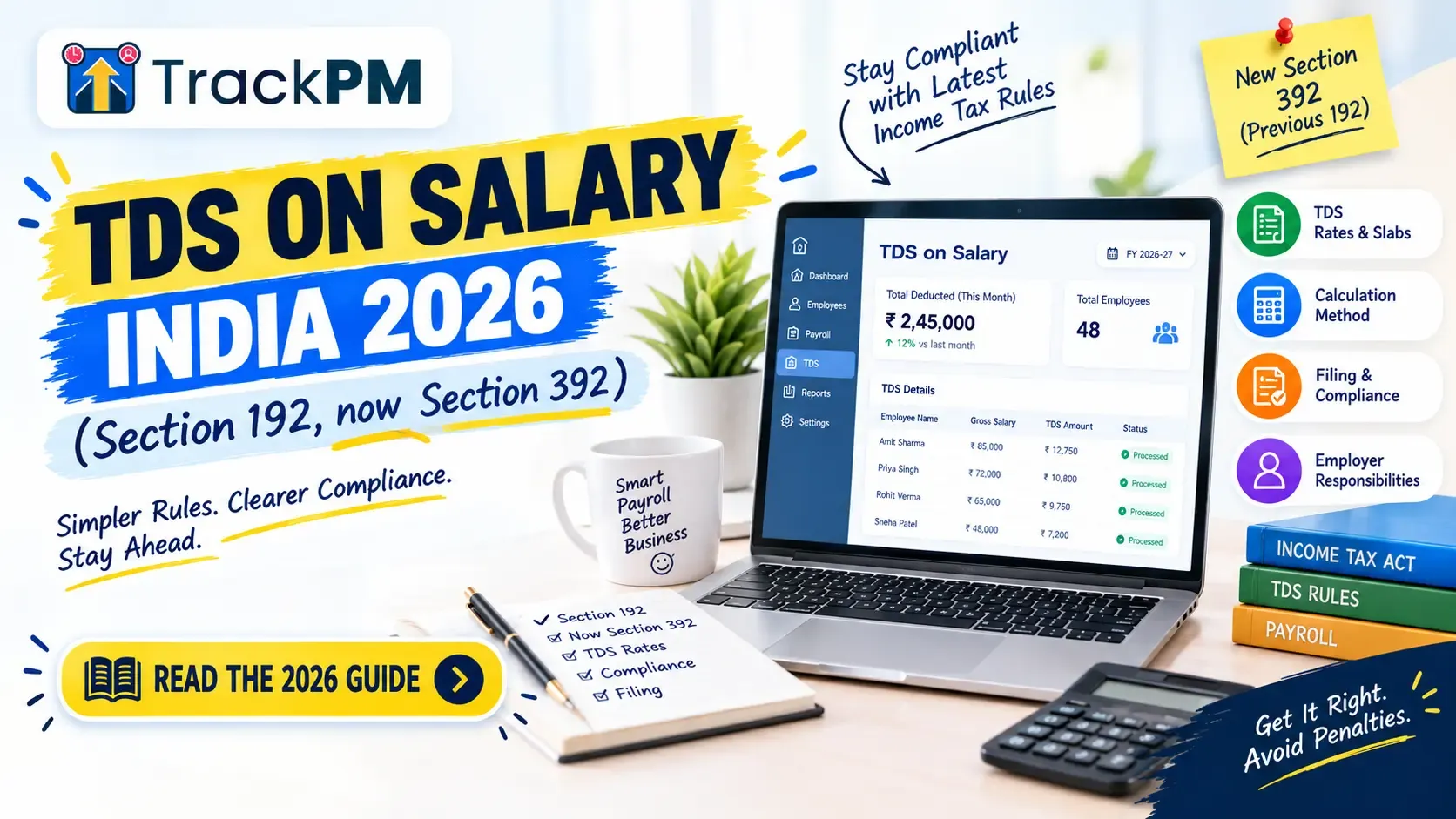
If you run payroll in India, you deduct tax at source from every salary. Most people still call this "Section 192", and most guides online are still written around it. But the Income-tax Act, 2025 replaced the 1961 Act from 1 April 2026, and the rule that makes employers deduct tax from salary is now Section 392.
The good news is that the tax rates did not change. This guide covers what did change, the FY 2026-27 slabs, how to work out monthly TDS with INR examples, and what an employer must do.
What Changed from 1 April 2026
| Income Tax Act, 1961 | Income-tax Act, 2025 | |
|---|---|---|
| TDS on salary | Section 192 | Section 392 |
| Rebate | Section 87A | Section 156 |
| Standard deduction | Section 16(ia) | Section 19 |
| Year terminology | Financial year / assessment year | Tax year |
| Annual TDS certificate | Form 16 | Form 130 |
Guidance published so far also names Form 122 for an employee's choice of tax regime and Form 124 for investment declarations. Form numbers are new, so check them on the income tax portal before updating your internal templates.
What did not change: the Finance Act 2026 kept the slabs, the ₹75,000 standard deduction, the ₹60,000 rebate, the surcharge bands and the 4% cess exactly as they were. Your monthly deduction is worked out the same way as before.
New Tax Regime Slabs for FY 2026-27 (Tax Year 2026-27)
The new regime is the default. Employers must deduct under the new regime unless the employee chooses the old one.
| Taxable income | Rate |
|---|---|
| Up to ₹4,00,000 | Nil |
| ₹4,00,001 – ₹8,00,000 | 5% |
| ₹8,00,001 – ₹12,00,000 | 10% |
| ₹12,00,001 – ₹16,00,000 | 15% |
| ₹16,00,001 – ₹20,00,000 | 20% |
| ₹20,00,001 – ₹24,00,000 | 25% |
| Above ₹24,00,000 | 30% |
Add 4% health and education cess on the tax. In the new regime, the standard deduction is ₹75,000. Employer NPS contributions within limits are also allowed. HRA, LTA, 80C and most other deductions are not.
Rebate: Under the new regime, no tax is payable if taxable income is up to ₹12,00,000. After the ₹75,000 standard deduction, that means salary up to ₹12,75,000 is effectively tax-free. Marginal relief applies for income just above the rebate limit.
Old regime (only if the employee opts in): nil up to ₹2,50,000, 5% to ₹5,00,000, 20% to ₹10,00,000 and 30% above. The standard deduction is ₹50,000 and the rebate is ₹12,500 for income up to ₹5,00,000.
How an Employer Calculates TDS on Salary
- Estimate the employee's total salary for the year. Include expected increments and bonuses.
- Apply the employee's regime. If the employee has not told you, use the new regime.
- Subtract the standard deduction. In the old regime, also subtract exemptions and deductions the employee has declared and proved.
- Compute annual tax using the slabs, then subtract any rebate and add 4% cess.
- Divide by the months remaining in the year. That is the monthly TDS. Re-estimate if salary changes.
Worked Examples in INR (New Regime, FY 2026-27)
These examples assume salary income only, with only the ₹75,000 standard deduction.
Example 1: Annual Salary ₹10,00,000
- Taxable income: ₹10,00,000 − ₹75,000 = ₹9,25,000
- Tax: ₹20,000 (on ₹4–8 lakh) + ₹12,500 (10% of ₹1,25,000) = ₹32,500
- Rebate: taxable income is under ₹12 lakh, so the rebate wipes out the tax.
- Monthly TDS: nil
Example 2: Annual Salary ₹15,00,000
- Taxable income: ₹14,25,000
- Tax: ₹20,000 + ₹40,000 + ₹33,750 (15% of ₹2,25,000) = ₹93,750
- Cess (4%): ₹3,750. Total: ₹97,500
- Monthly TDS: ₹97,500 ÷ 12 = ₹8,125
Example 3: Annual Salary ₹18,00,000
- Taxable income: ₹17,25,000
- Tax: ₹20,000 + ₹40,000 + ₹60,000 + ₹25,000 (20% of ₹1,25,000) = ₹1,45,000
- Cess (4%): ₹5,800. Total: ₹1,50,800
- Monthly TDS: ₹1,50,800 ÷ 12 = ₹12,567
Employer Obligations
- Deduct at the time of paying salary. Do not wait for year-end.
- Deposit the TDS with the government by the 7th of the following month. The deadline for March deductions is 30 April.
- Collect regime choices and investment declarations at the start of the year, and proofs later for old-regime employees.
- Collect details of previous employer salary and TDS from mid-year joiners. If you don't, each employer may allow the full standard deduction and lower slabs, so too little tax is deducted overall.
- Issue the annual TDS certificate. For tax year 2026-27, that is Form 130, due by 15 June 2027.
Common TDS Mistakes in IT Companies
Applying old-regime deductions to new-regime employees. HRA, 80C and LTA do not reduce TDS in the new regime.
Not asking for a regime choice. The new regime applies by default, so employees who want the old regime must tell you.
Ignoring mid-year joiners' earlier income. This leads to under-deduction and a tax demand on the employee later.
Using annual salary at the start and never re-estimating. Increments, bonuses and variable pay change the year's tax. Recalculate when they are paid.
Deducting but depositing late. Late deposit attracts interest and penalties, even when the deduction was correct.
Where TrackPM Fits
TrackPM's payroll module links salary to attendance, so loss-of-pay days are already reflected in the monthly salary you work TDS out from. Attendance and leave records sit in office management.
Frequently Asked Questions
Is Section 192 still valid in 2026?
Section 192 applied to salary paid up to 31 March 2026. From 1 April 2026, salary TDS is governed by Section 392 of the Income-tax Act, 2025. Many people still search for "Section 192", but the obligation and the working method are the same.
Is TDS deducted on a salary of ₹12 lakh?
Not under the new regime. After the ₹75,000 standard deduction, taxable income is ₹11,25,000. That is within the ₹12 lakh rebate limit, so the tax and the TDS are nil.
Which tax regime applies to TDS by default?
The new regime is the default. An employee who wants the old regime must tell the employer, and the employer then applies old-regime deductions on the basis of declarations and proofs.
When must an employer deposit TDS on salary?
By the 7th of the following month. For TDS deducted in March, the due date is 30 April.
What replaced Form 16?
For tax year 2026-27, the annual TDS certificate for salary is Form 130, due by 15 June 2027. Form 16 applies to earlier years.
Start Free Trial — No Credit Card Required · See TrackPM's Payroll Features