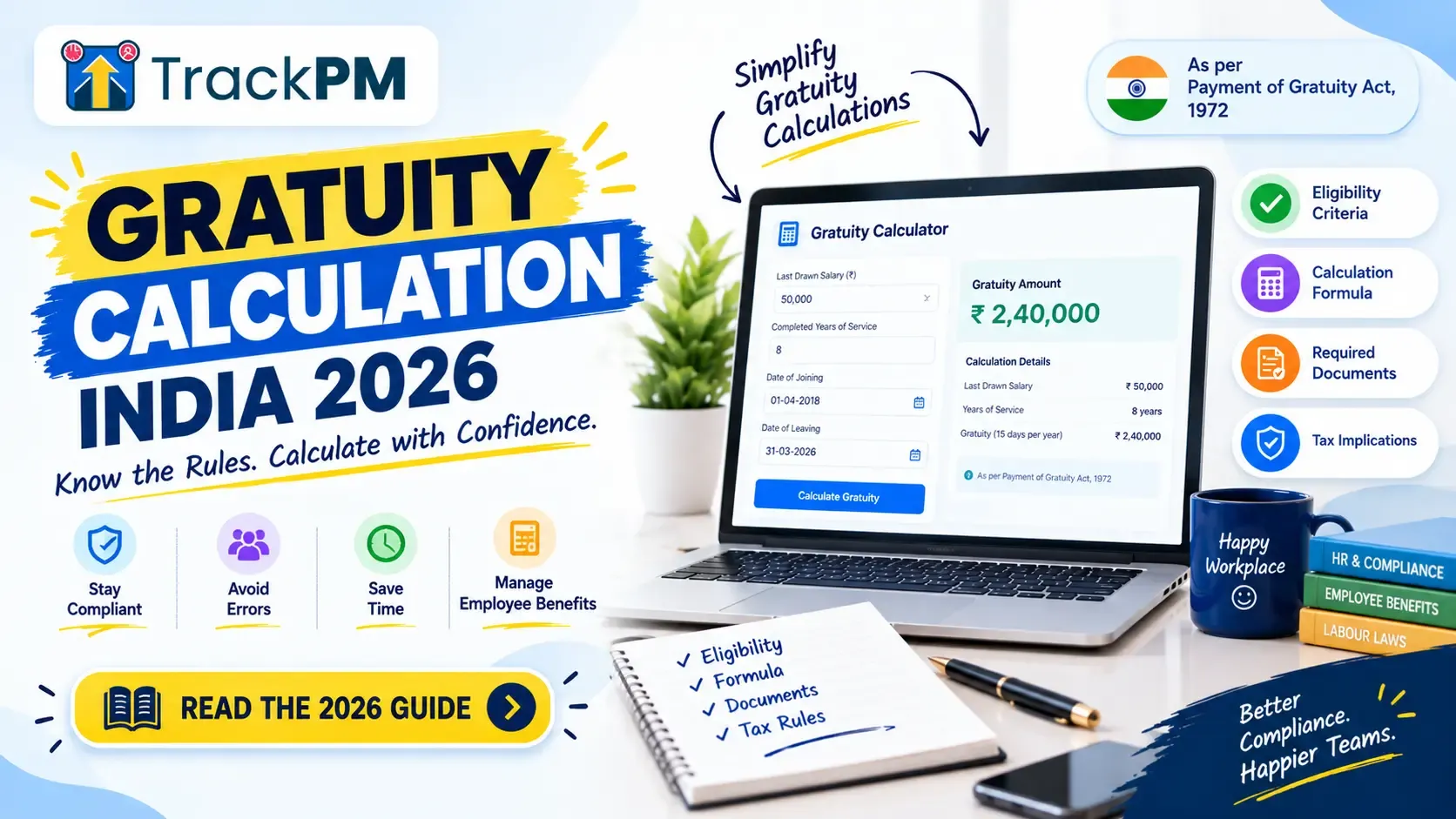
Gratuity is a lump-sum payment an employer makes to an employee for long service. It is one of the largest items in a full and final (FnF) settlement, and one of the most common sources of payroll disputes in Indian IT companies.
Since the Code on Social Security, 2020 came into force on 21 November 2025, gratuity has been governed by the Code, which carries forward the Payment of Gratuity Act, 1972 with two significant changes: gratuity for fixed-term employees after one year, and a minimum share of salary that must count as "wages".
This guide covers eligibility, the formula, the new rules, INR examples and what employers should do.
Who Is Eligible for Gratuity
| Employee type | Eligibility |
|---|---|
| Permanent employee | 5 years of continuous service, on resignation, retirement or superannuation |
| Death or disablement | No minimum service period |
| Fixed-term employee | Pro-rata gratuity after 1 year of continuous service (new under the Code) |
A fixed-term contract shorter than one year does not attract gratuity.
The Gratuity Formula
Gratuity = Last drawn wages × 15 ÷ 26 × completed years of service
- Wages means basic pay plus dearness allowance (and retaining allowance, where paid).
- 15 ÷ 26 converts monthly wages into 15 days' wages. Dividing by 26 treats a month as 26 working days.
- Completed years: a part year of more than six months counts as a full year. Six months or less is ignored.
HRA, conveyance, overtime, bonus and commission are normally left out of wages, subject to the 50% rule below.
The 50% Wage Rule
Under the Code, if the excluded components (HRA, conveyance and similar allowances) add up to more than half of total remuneration, the excess is added back to wages. Gratuity is then worked out on the higher figure.
For IT companies that keep basic low, this can raise gratuity noticeably.
Worked Examples in INR
Example 1: 7 Years 8 Months of Service, Wages ₹50,000
- 8 months is more than six, so service counts as 8 years.
- Gratuity = ₹50,000 × 15 ÷ 26 × 8 = ₹2,30,769
Example 2: 5 Years 2 Months of Service, Wages ₹30,000
- 2 months is six or less, so service counts as 5 years.
- Gratuity = ₹30,000 × 15 ÷ 26 × 5 = ₹86,538
Example 3: The 50% Rule (Simplified)
An employee has total monthly remuneration of ₹83,333, with ₹25,000 as basic and the rest as allowances. They leave after 6 years.
- Half of total remuneration is ₹41,667. Allowances of ₹58,333 exceed that by about ₹16,667.
- Wages for gratuity become ₹25,000 + ₹16,667 = ₹41,667.
- Without the rule: ₹25,000 × 15 ÷ 26 × 6 = ₹86,538
- With the rule: ₹41,667 × 15 ÷ 26 × 6 = ₹1,44,231
- Difference: about ₹57,700 more for the employee.
This is a simplified illustration. How your own pay components are classified affects the result, so confirm with your CA or payroll consultant.
Example 4: A Fixed-Term Employee, 1 Year, Wages ₹40,000
- Gratuity = ₹40,000 × 15 ÷ 26 × 1 = ₹23,077 (pro-rata, payable when the contract ends)
Limit, Tax and Payment
- Maximum gratuity: ₹20 lakh. This is the figure notified in 2018 under the old Act, and it has continued under the Code.
- Tax: gratuity is tax-free up to ₹20 lakh for private-sector employees covered by the law. Anything above is taxable.
- Payment timeline: within 30 days of it falling due.
What IT Employers Should Do
- Recalculate gratuity liability using the 50% rule. Salary structures with low basic and large allowances may now produce a higher liability than your records show.
- Track fixed-term hires. Anyone completing one year on a fixed-term contract now earns pro-rata gratuity.
- Keep service records accurate. Joining dates, breaks and continuous-service history decide eligibility. Attendance and leave records are the evidence.
- Calculate gratuity in the FnF process, not afterwards. Delays beyond 30 days can lead to disputes.
- Provide for the liability in your books. Your CA will usually book it based on an actuarial valuation.
Leave encashment is a separate FnF component with its own formula. See our guide to earned leave encashment in India.
Where TrackPM Fits
TrackPM's payroll module and office management keep attendance, leave and salary records in one place, which gives you the service history and wage data a gratuity calculation depends on.
Frequently Asked Questions
How is gratuity calculated in India in 2026?
Gratuity = last drawn wages × 15 ÷ 26 × completed years of service. Wages means basic plus dearness allowance. A part year of more than six months counts as a full year.
Is 5 years of service still required for gratuity?
Yes, for permanent employees, except on death or disablement. Fixed-term employees are the exception: under the Code on Social Security they earn pro-rata gratuity after 1 year of continuous service.
What is the maximum gratuity amount?
₹20 lakh. Gratuity up to ₹20 lakh is also tax-free for private-sector employees covered by the law.
What is the 50% wage rule for gratuity?
If allowances and other excluded components exceed 50% of total remuneration, the excess is added back to wages. Gratuity is then calculated on the higher wages figure.
When must the employer pay gratuity?
Within 30 days of it falling due, normally as part of the FnF settlement.
Start Free Trial — No Credit Card Required · See TrackPM's Payroll Features