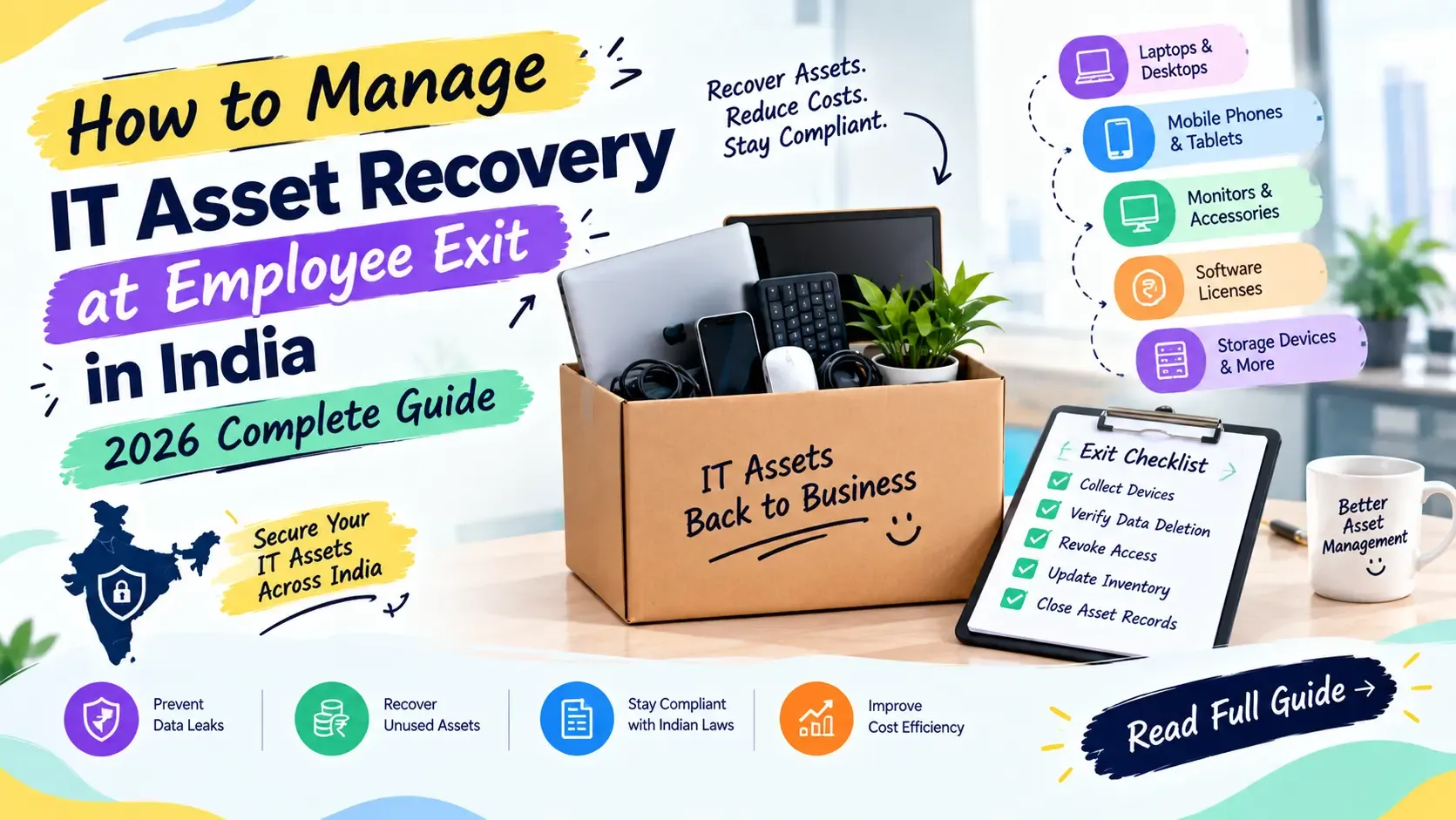


If your Indian startup has more than 15 employees, you are almost certainly managing IT assets — laptops, mobile phones, monitors, software licenses, networking equipment — in a spreadsheet that was last fully accurate about three months ago.
You know this is true. You also know the exact moment the spreadsheet stopped working: when your first employee resigned and you realised, three weeks after their last day, that you had no clear record of which laptop had been returned and which one was still sitting in their home office in a different city.
This guide covers what IT asset management software actually does, what to look for specifically for Indian startups, how it handles Indian depreciation requirements under the Companies Act 2013, and which tools are worth considering in 2026.
What IT Asset Management Software Does
IT Asset Management (ITAM) software is a digital system that tracks every physical and digital asset a company owns — from the moment it is purchased to the moment it is disposed of or written off.
For an Indian IT startup, this means:
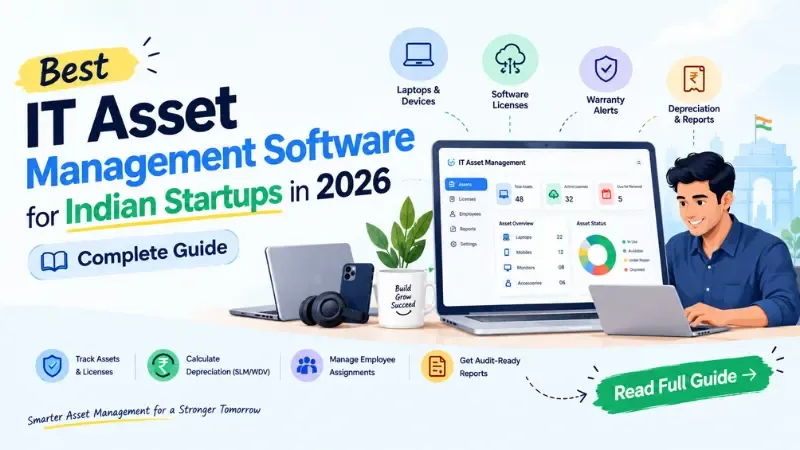
- Hardware tracking: Every laptop, desktop, mobile phone, tablet, server, router, printer, and peripheral is registered in the system with its serial number, purchase date, cost, warranty expiry, and assigned employee. When the employee changes, the system records the handover. When the warranty expires, the system sends an alert.
- Software license management: Every SaaS subscription, software license, and tool your company pays for is tracked with renewal dates, user counts, and cost per seat. You see, at a glance, which licenses are about to renew (and whether you still need them) and which licenses are assigned to employees who have since left the company.
- Depreciation calculation: Under Schedule II of the Companies Act 2013, Indian companies must depreciate fixed assets — including IT equipment — using either the Straight Line Method (SLM) or the Written Down Value (WDV) method. Asset management software calculates this automatically and generates the depreciation schedules your finance team and auditors need.
- Assignment and return tracking: When a new employee joins, their asset assignment is part of Day 1. When they leave, the system flags all assets assigned to them — before their last day, not after.
- Audit-ready reports: One-click asset register, depreciation schedule, warranty expiry report, and asset-by-employee report — ready for statutory audit, investor due diligence, or DPIIT reporting.
The Companies Act 2013 Requirement Indian Startups Often Miss
One area where Indian IT startups consistently have gaps is asset depreciation compliance under the Companies Act 2013.
Under Schedule II of the Act, companies incorporated in India must depreciate fixed assets based on their prescribed useful life. For computers and data processing units — the primary asset category for IT startups — the prescribed useful life is 3 years under SLM and approximately 63.16% depreciation per year under WDV.
The two methods work as follows:
- Straight Line Method (SLM): Depreciation is calculated as a fixed percentage of the original cost each year. For a laptop purchased at ₹80,000 with a 3-year useful life and 5% residual value: Annual depreciation = (₹80,000 − ₹4,000) ÷ 3 = ₹25,333 per year.
- Written Down Value (WDV) Method: Depreciation is calculated as a percentage of the remaining book value each year. The same laptop at 63.16% WDV rate: Year 1: ₹50,528 depreciation (book value falls to ₹29,472). Year 2: ₹18,619 depreciation (book value falls to ₹10,853). Year 3: remaining value written off.
Most Indian IT startups either ignore this requirement (creating audit risk) or calculate it manually in Excel (creating calculation errors). Asset management software that handles Indian depreciation methods eliminates both problems — the system calculates correctly, generates the schedule automatically, and produces the reports your statutory auditor needs.
5 Signs Your Indian Startup Needs Asset Management Software
- 1. You discovered a missing laptop during an employee exit.
If you have ever had to chase a former employee for equipment after their last day because nobody flagged it before they left — you need ITAM software. Asset software triggers the return checklist before the exit date. - 2. You are paying for software licenses that nobody uses.
SaaS subscription sprawl is one of the biggest cost leakages for Indian IT startups. A 20-person team often has 12–15 active SaaS subscriptions, of which 3–4 have seats assigned to employees who left 6 months ago. License management in asset software recovers this cost automatically. - 3. Your finance team calculates depreciation in Excel.
Manual depreciation calculations in Excel are error-prone and impossible to audit. As your asset base grows (25 devices becomes 50, becomes 100), the Excel approach breaks entirely. - 4. You cannot produce an asset register in under 5 minutes.
When an investor asks for your asset register during due diligence, the answer "let me compile that from our spreadsheet" loses confidence immediately. A proper asset register should be a one-click report. - 5. You have no warranty expiry alerts.
Laptops go out of warranty, get repaired at cost, and nobody knew the warranty had expired 3 months earlier. Asset software alerts you 30–60 days before warranty expires so you can extend coverage or plan replacement.
Top IT Asset Management Options for Indian Startups in 2026
TrackPM — Best for Indian IT startups needing ITAM + PM + HR in one platform
TrackPM's asset management module is built specifically for Indian IT startups and companies with 5–200 employees. It includes hardware and software license tracking, SLM and WDV depreciation calculation under Companies Act 2013, employee assignment with digital acknowledgement, warranty alerts, maintenance scheduling, and one-click audit reports.
The key differentiator: TrackPM connects asset management directly to employee onboarding and offboarding workflows, project management (Kanban and Scrum boards), time tracking, attendance, and payroll — all in one pay-per-use platform. For Indian IT startups that need ITAM but do not want to add another standalone tool to their existing stack, TrackPM is the most practical option.
Best for: Indian IT startups and companies with 5–200 employees needing asset management alongside project management and HR. Pricing: INR, Use and Pay model.
ManageEngine AssetExplorer — Best for mid-large Indian enterprises
ManageEngine is headquartered in Chennai and has the deepest presence in the Indian enterprise market. Its ITAM platform offers network-based asset discovery, detailed configuration management, software license compliance, and extensive reporting. It is used across BFSI, government, education, and manufacturing sectors in India with both on-premise and cloud deployment options.
Best for: Indian enterprises with 200+ employees, dedicated IT administrators, and complex asset environments. Pricing: From approximately ₹1,195/year for the base plan; mid-market configurations run significantly higher.
Freshservice — Best for startups needing ITSM + ITAM together
Freshworks was founded in Chennai and Freshservice is its cloud-native ITSM platform with a built-in ITAM module. It handles asset tracking alongside IT service management — helpdesk tickets, incident management, and change management — making it a strong choice for IT teams that need service desk and asset visibility in one tool. Per-agent pricing can become expensive at scale.
Best for: IT teams of 20–150 people that need helpdesk functionality alongside asset tracking. Pricing: From approximately ₹1,400/agent/month ($19 USD).
Snipe-IT — Best free open-source option
Snipe-IT is a free, open-source asset management tool that Indian startups can self-host. It handles hardware and software asset tracking, employee assignments, and basic reporting. No depreciation calculation, no payroll integration, no HR features — but for a team that only needs asset tracking and has technical capacity to self-host, it is a cost-effective starting point.
Best for: Early-stage startups (under 15 employees) with a developer who can self-host. Pricing: Free self-hosted; cloud-hosted from $39.99/month.
How to Set Up Asset Management for Your Indian Startup in 30 Minutes
Step 1 (10 min)
Create your asset categories — IT Hardware (laptops, phones, peripherals), Software Licenses (SaaS tools, development licenses), Office Equipment (furniture, AV equipment), and Other.
Step 2 (10 min)
Add all existing assets. For each: name, serial number, purchase date, purchase cost, warranty expiry date, depreciation method (SLM or WDV), and current assigned employee.
Step 3 (5 min)
Configure alerts — warranty expiry (30 days notice), license renewal (60 days notice), maintenance due date alerts.
Step 4 (5 min)
Add the asset assignment step to your employee onboarding checklist and the asset return step to your employee offboarding checklist. These two integrations with HR processes are what keep the asset data accurate long-term.
Frequently Asked Questions
What is IT asset management software and why do Indian startups need it?
IT asset management software tracks every physical and digital asset a company owns — laptops, desktops, monitors, software licences, and accessories — including which employee each asset is assigned to, its purchase value, depreciation under Companies Act 2013, warranty status, and maintenance history. Indian startups need it to prevent asset loss at employee exit, maintain accurate financial records for statutory audit, and avoid paying for software licences on devices no longer in active use.
What is the best IT asset management software for Indian startups in 2026?
For Indian startups needing asset management integrated with HR and project management on pay-per-use pricing, TrackPM is the most comprehensive India-built option. For standalone enterprise ITAM, Freshservice (India-based Freshworks) and ManageEngine AssetExplorer are well-established. For very small teams (under 15 people), a well-structured Excel asset register is sufficient until the team outgrows manual tracking — typically at 20–30 assets.
How should Indian startups track depreciation on IT assets?
Under Schedule II of the Companies Act 2013, computers have a useful life of 3 years and a residual value of 5% of original cost. Use either SLM (straight-line, same depreciation each year) or WDV (declining balance, higher depreciation in early years — 63.16% per year for computers). For Income Tax purposes, use 40% WDV on the block of assets as per Appendix I of the Income Tax Rules. Maintain both schedules — one for your books of accounts, one for your tax return.
How do Indian startups prevent IT asset loss when employees resign?
The most effective prevention: maintain a real-time asset register with serial numbers and employee assignment data; make FnF settlement explicitly contingent on verified asset return in your employment agreement; send a formal asset return notice within 3 days of resignation; and have a pre-paid courier process for remote employees. A signed Asset Allocation Form at the time of issuance establishes the legal bailee relationship under Section 316 of the Bharatiya Nyaya Sanhita 2023 (formerly IPC Section 405) and enables recovery action if assets are not returned.
What information should an IT asset register include for an Indian company?
A complete IT asset register for an Indian company should include: asset name and description, brand and model, serial number, asset tag, purchase date, purchase cost (excluding GST), current book value (depreciated under Companies Act), warranty expiry date, assigned employee name and employee ID, assignment date, current location, and maintenance history. For software licences: licence key, number of seats, renewal date, and assigned devices. This information is required for statutory audit, insurance claims, and legal recovery action.
Conclusion
A stale spreadsheet is not an asset register — it is a liability waiting to surface at the worst possible moment, whether that's an employee exit, an audit, or investor due diligence. Indian IT startups that connect asset tracking to onboarding, offboarding, and Companies Act depreciation rules stop chasing equipment after the fact and start managing it proactively. TrackPM brings IT asset management together with project management, time tracking, and payroll on one Indian platform.