

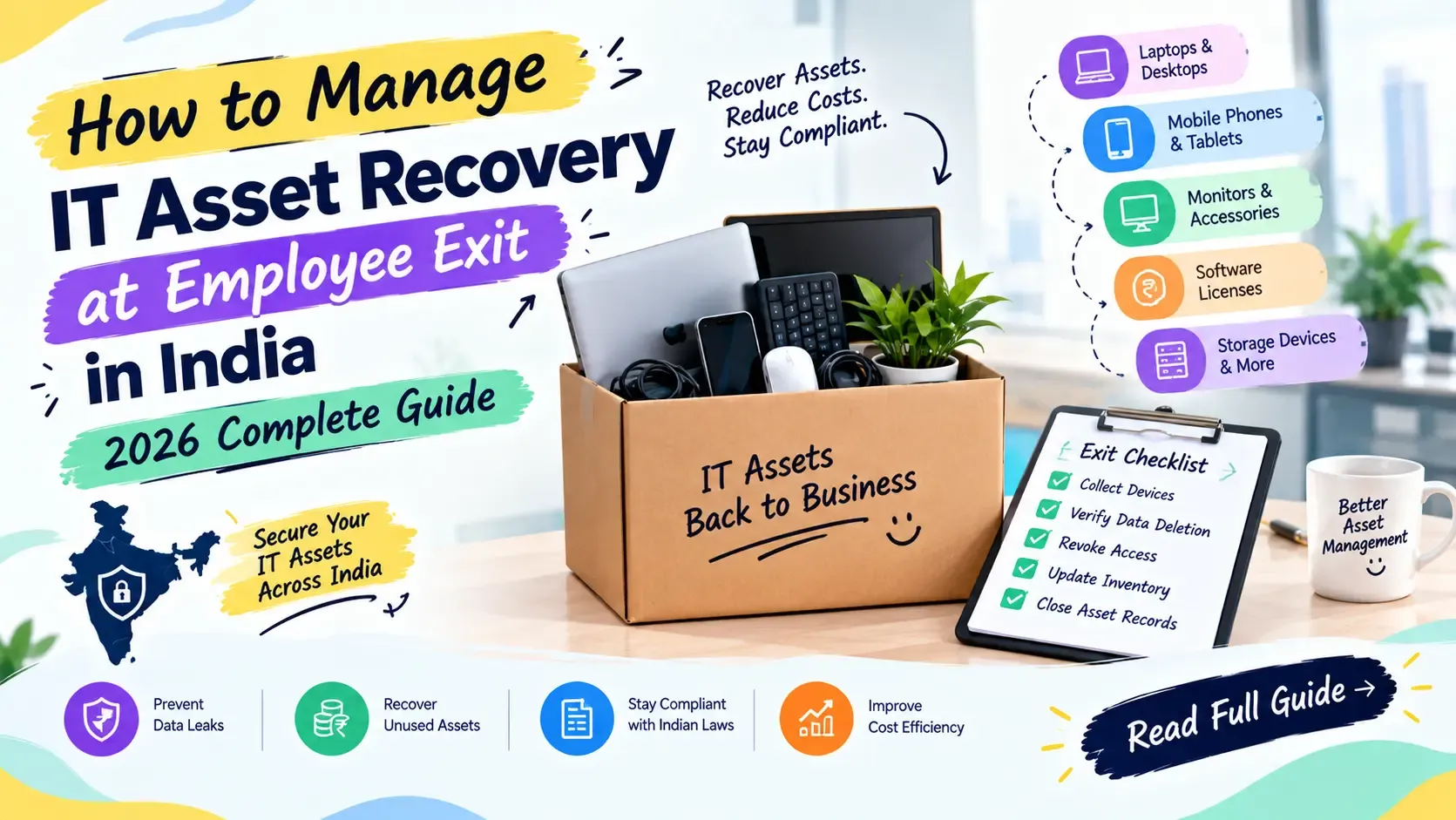
How to Manage IT Asset Recovery at Employee Exit in India — 2026 Complete Guide
Departing employees often leave with company laptops, licences and access still active. This 2026 guide covers the legal basis for IT asset recovery in India, a 5-step exit recovery process, what the Asset Allocation Form must include, a worked INR cost example, and how TrackPM automates recovery at exit.
By Veenu Singh, Founder & CEO, TrackPM · Last updated: September 2026 · 8 min read
The resignation email arrives. Your HR team starts the offboarding process — exit interview, knowledge transfer, notice period, full and final settlement. And somewhere in that checklist, often near the bottom, is a line that says: "Collect company assets."
By the time it is actioned, the laptop is at the employee's home in Pune. The licensed software is still activated on a device you no longer control. The network access card, the external hard drive, the company SIM card — somewhere in transit between their last working day and your IT storeroom.
A global survey found that 71% of HR professionals reported that departing employees did not return company-owned equipment. For Indian IT companies with 15–100 employees, a single unrecovered laptop at ₹70,000–₹1,20,000 replacement value is a meaningful loss. Ten unrecovered assets across a year of attrition is a ₹7–12 lakh inventory gap that never appears on the P&L but shows up immediately in any asset audit.
This guide covers the legal basis for asset recovery in India, the exact 5-step process, what the asset return form must include, the most common points where recovery breaks down, and how TrackPM's asset management module prevents losses before they happen.
Why IT Asset Recovery Fails in Indian Companies
Most Indian IT companies lose assets not because employees are dishonest — but because the recovery process has no system behind it. The pattern is consistent:
- No asset register at the time of exit. When someone resigns, the HR team does not know exactly what assets are in that person's possession — because the asset was issued 18 months ago and tracked in a spreadsheet that no one has updated since. The serial number is not on record. The purchase date is not on record. Whether it was a company laptop or a BYOD arrangement is not clear. Recovery cannot begin until someone manually traces the asset — which takes days and often fails.
- The F&F settlement is processed before the assets are returned. Full and Final settlement is typically released on the last working day or within the notice period. Once the employee receives their FnF, the leverage for asset return is gone. The correct sequence is: assets returned and verified first, then FnF released. Most Indian companies do this in the wrong order.
- Remote and hybrid teams have no structured return process. A developer in Hyderabad who worked remotely for 2 years and resigns has a company laptop at their home. There is no established courier protocol, no pre-paid return kit process, and no documented responsibility assignment for who initiates the return. The asset simply stays where it is.
- No legal notice is sent when assets are not returned. Indian companies are often reluctant to send a formal notice to a former employee over a laptop. But without a documented recovery attempt, even legal action becomes difficult later.
The Legal Basis for IT Asset Recovery in India
Indian employers have clear legal standing to recover company-issued IT assets from departing employees. Two laws are directly relevant:
Criminal Breach of Trust — Bharatiya Nyaya Sanhita 2023 (formerly IPC Section 405)
When an employer issues a laptop to an employee, the employee becomes a "bailee" of that asset under Indian law. If the employee fails to return the asset after the employment ends and after a formal demand has been made, this constitutes criminal breach of trust under Section 316 of the Bharatiya Nyaya Sanhita 2023 (which replaced Section 405 of the Indian Penal Code from July 2024). The asset is not a gift — it is a trust. A signed Asset Allocation Form at the time of issuance is the document that establishes this bailee relationship formally.Information Technology Act 2000
If a former employee continues to access company data, software, or systems from a device they have retained after employment ends, they are potentially in violation of Section 43 and Section 66 of the IT Act 2000 — which covers unauthorised access to computer systems and data. This creates an independent ground for legal action beyond the physical asset value.Practical implication for Indian IT companies: The Asset Allocation Form signed at the time of issuance is your most important document. It must include: the employee's name, the asset description, the serial number, the asset value at time of issuance, and a clear statement that the employee is a bailee of the asset and must return it upon separation. Without this form, even a valid legal claim becomes difficult to prosecute.
5-Step IT Asset Recovery Process for Indian IT Companies
Step 1 — Run an Asset Audit on the Day the Resignation Is Accepted
The moment a resignation is accepted — not on the last working day, on day one of the notice period — pull a complete list of every asset assigned to that employee from your asset register. Every laptop, desktop, monitor, keyboard, mouse, external drive, company SIM, software licence, access card, and security token. Confirm the serial number of each item.This gives you a verified list to work against. If you do not have this data in your system, the recovery process starts with a manual investigation instead of a structured checklist — and that is where things go wrong.
Step 2 — Send a Formal Asset Return Notice Within 3 Days of Resignation
Do not wait until the last working day. Send the employee a formal written notice (email with read receipt is sufficient — a physical letter is better for high-value assets) listing every asset they are expected to return, the expected condition of each, and the date by which return must be completed. For remote employees, include courier instructions and a return address.This document serves two purposes: it creates a paper trail for legal action if needed, and it signals to the employee that the company is tracking this formally — which significantly improves voluntary compliance.
Step 3 — Collect and Verify Assets Before the Last Working Day
For office-based employees: asset collection should happen on the second-to-last working day — not the last day, when the employee has farewell conversations and exits quickly. Assign a specific IT team member to receive, inspect, and log each returned asset.For remote employees: initiate the courier process at least 7 working days before the last working day. Pre-paid courier labels should be sent to the employee with packaging instructions. Confirm receipt and physical condition upon arrival.
Inspection checklist for each returned asset:
- Physical condition: scratches, screen damage, broken ports
- Functional test: does it power on, does the keyboard and trackpad work
- Serial number: does it match the Asset Allocation Form
- Data: is the device wiped or does it need remote wipe before reissue
- Accessories: charger, bag, dock, external drives — all listed items present
Step 4 — Get a Signed Asset Return Acknowledgement
Once assets are collected and verified, get a written acknowledgement signed by the employee. This document states: the list of assets returned, the date of return, the condition at time of return, and confirmation that no company data or access remains on personal devices.This acknowledgement protects both parties. The employee has proof they returned the assets. The company has proof the assets were received in stated condition. This document closes the loop on any future dispute — particularly around damage claims or missing accessories that might be raised during FnF.
Step 5 — Release FnF Settlement AFTER Asset Return Is Confirmed
This is the single process change that most significantly improves asset recovery rates. The FnF settlement must be contingent on asset return confirmation. Include a clause in your employment agreement and your exit policy: "Full and Final settlement will be processed within [X] working days after all company assets have been returned and verified."If assets are not returned before the FnF deadline, two options: (a) deduct the depreciated book value of the unrecovered asset from the FnF amount (requires explicit policy language and employee consent in the employment agreement), or (b) release FnF and send a legal notice for recovery — your lawyer will advise based on asset value.
What the Asset Allocation Form Must Include
The Asset Allocation Form is your foundation document for legal recovery. Every company should have one — signed by the employee at the time of issuance, not at exit.
A compliant Asset Allocation Form for Indian IT companies includes:
| Section | What it must contain |
|---|---|
| Employee details | Full name, employee ID, designation, department, joining date |
| Asset details | Asset description, brand, model, serial number, asset tag number, purchase date, purchase value (excluding GST), current book value (depreciated) |
| Assignment details | Date of issuance, purpose of assignment (office use, work from home, travel, project-specific), expected return date if temporary |
| Terms | A clear statement that the employee is a bailee of the asset, that it remains company property, that it must be returned in the condition received (reasonable wear and tear excepted), and that failure to return on separation constitutes criminal breach of trust under Section 316 of the Bharatiya Nyaya Sanhita (formerly IPC Section 405) |
| Signature | Employee signature with date, witnessed by HR representative |
Keep one signed copy in the employee's HR file. Keep one in your asset management system linked to the specific asset record.
The Cost of Getting This Wrong — An INR Example
Consider a 40-person Indian IT company with typical attrition of 25% per year — 10 employees per year.
Each employee is issued: 1 laptop (₹85,000), 1 headset (₹3,500), 1 external hard drive (₹4,000). Total asset value per employee: ₹92,500.
With no structured recovery process and a 71% return rate: 3 out of 10 employees do not fully return assets. Average unrecovered value per employee: ₹50,000 (partial recovery — laptop returned, accessories missing, or laptop retained entirely).
Annual asset loss: 3 × ₹50,000 = ₹1,50,000 per year — not counting software licences that remain active on unreturned devices.
Over 3 years without a structured recovery process: ₹4,50,000 in direct asset loss, plus an equal or greater amount in unreported software licence overpayments.
This is before factoring in data security risk — an unreturned laptop with company data, client credentials, or codebase access is not just a ₹85,000 loss. It is a DPDPA 2023 compliance exposure.
How TrackPM Manages IT Asset Recovery at Employee Exit
TrackPM's asset management module connects directly to your employee directory. When an employee's exit date is entered in the system, it automatically:
- Generates a complete list of all assets currently assigned to that employee
- Triggers an asset return checklist sent to the IT team and HR team
- Sets a return deadline based on the exit date
- Flags any assets not marked as returned 3 days before the FnF settlement date
- Records the return condition and updates the asset register when assets are received
- Moves returned assets back to "available" inventory with a data-wiped status flag
For Indian IT companies managing 20–200 assets across multiple offices in Bengaluru, Pune, Hyderabad, Delhi, and Chennai — with remote team members across even more locations — this automated trigger removes the human dependency from the recovery process. Assets do not get missed because the exit happened during a sprint delivery crunch and nobody remembered to check the asset register.
Frequently Asked Questions
Can an Indian employer deduct the cost of an unreturned laptop from the employee's final settlement?
Deducting asset value from FnF settlement requires two things: (1) explicit written consent from the employee, typically in the employment agreement or a separately signed asset policy document, and (2) the deduction must not reduce the employee's wages below the minimum wage for their category. Without prior written consent, unilateral FnF deductions can be challenged under the Code on Wages 2019 (which replaced the Payment of Wages Act 1936). The legally cleaner approach is to release FnF and pursue asset recovery through a formal legal notice simultaneously.What is the legal basis for recovering company assets from an employee in India?
Company assets issued to an employee create a bailee relationship under Indian law. The employee holds the asset in trust for the company. Failure to return the asset after a formal demand constitutes Criminal Breach of Trust under Section 316 of the Bharatiya Nyaya Sanhita 2023 (formerly Section 405 of the Indian Penal Code). If the employee continues to access company data on the unreturned device, they may also violate Section 43 and Section 66 of the Information Technology Act 2000. A signed Asset Allocation Form at the time of issuance is the document that establishes the bailee relationship formally and enables legal action.How do Indian IT companies recover laptops from remote employees who resign?
The structured process for remote laptop recovery: (1) issue a formal asset return notice within 3 days of resignation with specific return instructions, (2) send a pre-paid courier kit with packaging materials to the employee's registered address at least 7 working days before the last working day, (3) track the courier until the device arrives at the company's specified address, (4) inspect and verify the device against the Asset Allocation Form, (5) get a signed return acknowledgement before releasing FnF. The most effective preventive measure is to build the return process into the initial issuance — include return instructions in the laptop box from day one.What assets should be recovered from an employee on exit in an Indian IT company?
Every asset documented in the employee's Asset Allocation Form: laptops, desktops, monitors, keyboards, mice, headsets, company mobile phones, SIM cards, external hard drives, USB security keys, access cards, physical security tokens, printed materials with confidential information, and any other hardware or equipment. Software licences tied to the employee's credentials — whether on their device or cloud-based — must also be deactivated. The checklist should also include: revoking email access, VPN access, GitHub/GitLab access, client system access, and any shared credential accounts the employee had access to.How can Indian IT companies prevent asset losses at employee exit?
Prevention is more effective than recovery. The three most impactful prevention measures: (1) maintain a real-time asset register with serial numbers and employee assignment data — not an annual spreadsheet update, (2) make FnF settlement explicitly contingent on verified asset return in your employment agreement and exit policy, (3) build the return process into the initial issuance — include return instructions, pre-paid courier label details, and the asset return form in the laptop box from day one, so the employee knows from day one that the return process is structured and tracked.Conclusion
Track every asset assigned to every employee — and automate recovery at exit.
Start Free Trial — No Credit Card Required · See TrackPM's Asset Management Features