


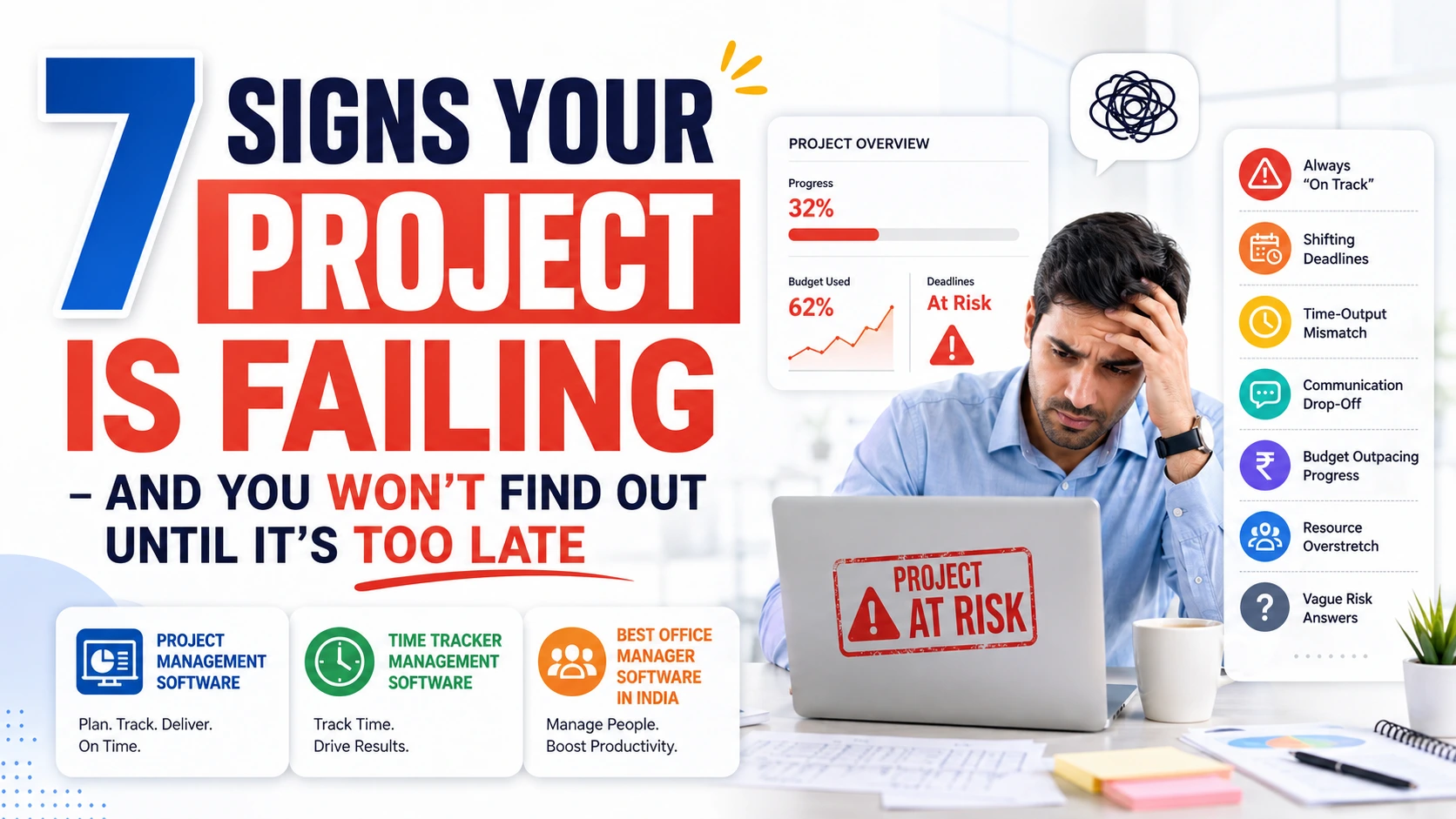
Quick Reference: Symptom vs. Root Cause
- Always "on track"
- Looks like: Every update is positive
- Usually means: No objective data, just self-reporting
- Shifting deadlines
- Looks like: Small delays, repeatedly
- Usually means: Compounding dependency risk
- Time-output mismatch
- Looks like: Hours logged don't match progress
- Usually means: Scope creep or unclear requirements
- Communication drop-off
- Looks like: Fewer questions, slower replies
- Usually means: Team disengagement or hidden blockers
- Budget outpacing progress
- Looks like: 60% spent, 30% done
- Usually means: Poor forecasting or scope changes
- Resource overstretch
- Looks like: Same names on every project
- Usually means: No visibility into total workload
- Vague risk answers
- Looks like: No one can name real risks
- Usually means: Risk assessment was never done properly
1. Status Updates Always Say "On Track"
If every weekly update sounds the same — positive, brief, no friction — that's not necessarily good news. It often means no one is digging past the surface.
People naturally round their progress up, especially when they're worried about being blamed for delays. PMI's research on causes of failure consistently points to unclear goals, weak stakeholder engagement, and poor communication as the top recurring culprits — and all three hide comfortably behind a verbal "we're fine."
What to check: Pull live data from your project management software instead of relying on what people say in meetings. If the dashboard and the verbal update don't match, that gap is your real signal.
2. Deadlines Keep Quietly Shifting
A missed deadline now and then is normal. But small, repeated slips — two days here, three days there, never formally flagged — usually point to a slow-motion failure already underway.
Here's the part that's easy to underestimate: delays compound. A two-day slip on an early task can easily turn into a two-week delay by the time it works through every dependent task downstream.
What to check: Map dependencies, not just individual deadlines. One late task rarely stays contained.
3. Time Tracking Data Doesn't Match Output
When logged hours don't line up with what's actually been delivered, something's off — tasks are taking longer than planned, time isn't being logged honestly, or both.
This is exactly the gap that good time tracker management software is built to close. Rather than just totaling hours, modern time-tracking tools map effort against specific tasks and deliverables, so you can see where time is going, not just how much.
What to check: Compare logged hours against percentage-of-task-completion weekly. A repeated mismatch is an early flag for scope creep or a skills gap on the team — and PM Study Circle's analysis notes that projects without formal change management processes are 35% more likely to exceed costs or miss deadlines, which is exactly the kind of drift this comparison catches early.
4. Communication Has Gone Quiet
It sounds counterintuitive, but a sudden drop in communication is often more worrying than an increase in complaints. Fewer questions, slower replies, less back-and-forth — these usually mean people have either disengaged or stopped feeling safe raising concerns.
Signs to watch for:
- Lower participation in meetings than usual
- Fewer clarifying questions being asked
- Noticeably slower response times on messages or emails
5. Budget Burn Rate Is Outpacing Project Progress
If 60% of the budget is spent but only 30% of the work is done, the math is already telling you something leadership hasn't accepted yet. This gap often goes unnoticed simply because nobody is tracking spend against progress side-by-side in real time.
What to check: Most decent project management platforms include a burn-rate dashboard that flags this automatically — use it weekly, not just at milestone reviews.
6. Resources Are Being Pulled in Too Many Directions
When the same two or three people show up on every project's task list, quality and speed both quietly erode — often invisibly, because no single manager sees the full picture of what any one person is actually carrying.
This is especially common in growing Indian businesses, where small teams often wear several hats at once. Without something like the Best Office Manager Software in India to track workload distribution across departments and projects, overallocation tends to stay invisible until burnout or visible mistakes force the issue.
What to check: Look at total assigned hours per person across all active projects, not just the one you're managing.
7. No One Can Clearly Explain Project Risks
Ask your team, "What could realistically go wrong here?" If the answer is vague, rehearsed, or there isn't one — that's a problem in itself. Either risk assessment was never done properly, or it was done once and forgotten.
A healthier project culture usually includes:
- A risk register that actually gets updated, not just created once
- Open channels where raising a concern doesn't feel like inviting blame
- Leadership that responds to bad news constructively rather than punitively
Why Real-Time Data Beats Verbal Updates
All seven signs trace back to the same root cause: a lack of objective, real-time data. Verbal status updates are shaped by human incentives — nobody wants to be the bearer of bad news in a Monday meeting. Data doesn't have that problem.
A well-connected set of tools closes this gap in practice:
- Project management software centralizes tasks, deadlines, and dependencies in one visible place, so "status" isn't a matter of opinion.
- Time tracker management software shows exactly where hours are going, exposing effort-versus-output mismatches before they snowball.
- The best office manager software in India helps growing companies manage workload, attendance, and resourcing across departments — particularly useful for small and mid-sized businesses scaling faster than their processes.
Frequently Asked Questions
What are the early warning signs that a software project is failing?
The 7 early warning signs covered in this guide: status updates always say "on track" even when they shouldn't; deadlines keep quietly shifting; time tracking data doesn't match actual output; communication has gone quiet; budget burn rate is outpacing project progress; resources are being pulled in too many directions; and no one can clearly explain the project's risks. Each one is visible weeks before the deadline crisis — if you are looking at real data rather than verbal updates.
How can Indian IT managers detect project problems before the deadline?
The most reliable detection methods: weekly sprint velocity tracking (comparing completed vs committed tasks over time), daily blocked task review (any task blocked for more than 2 days needs escalation), bi-weekly budget vs delivery burn rate comparison, and a direct 1:1 question to each developer every Friday: 'Is anything blocking you that you haven't raised yet?' Most project problems are visible 3–4 weeks before they become crises — the challenge is creating a system that surfaces them systematically rather than waiting for them to escalate.
Why do Indian IT projects fail despite skilled developers?
The most common causes of IT project failure in India that are unrelated to developer skill: unclear or changing requirements that are not version-controlled; absence of a dedicated product owner making prioritisation decisions; sprint planning that consistently over-commits beyond team capacity; blocked tasks that stay in 'In Progress' status instead of a visible Blocked column; and client communication gaps where status updates happen monthly instead of weekly. Most Indian IT project failures are process problems, not technical ones.
How does project tracking software help prevent IT project failures?
Project tracking software prevents failures by making the warning signs visible before they become crises: real-time sprint velocity charts show declining delivery capacity over time; blocked task visibility means problems are not hidden in individual developer inboxes; task completion rate by person identifies consistent under-delivery patterns; and timeline vs actual progress views give managers an honest picture of whether the project will hit its deadline based on current trajectory, not optimistic estimates.
What should a project manager do when they identify a failing IT project?
Immediate actions when a project shows failure signals: call a scope review meeting with the client or product owner to re-prioritise the remaining work; run a retrospective specifically focused on blockers and identify root causes rather than symptoms; reduce the sprint commitment by 20–30% for the next two sprints to create a recovery buffer; escalate any external dependencies that are blocked; and update the delivery timeline based on actual velocity data rather than the original estimate. Communicating a revised timeline early is always better than missing the original deadline without warning.
The Real Takeaway
Project failure is rarely a single dramatic event. It's usually a handful of small, easy-to-dismiss signals — an upbeat status report, a quietly shifted deadline, a budget chart that doesn't quite add up — that nobody connected in time. None of the seven signs above require advanced tools to catch. They require looking at the right data, regularly, before the meeting tells you what you already should have known.
The teams that consistently avoid late-stage project disasters aren't the ones with the fanciest dashboards. They're the ones who treat a quiet week, an upbeat update, or a "minor" two-day delay as worth a second look — every time.