

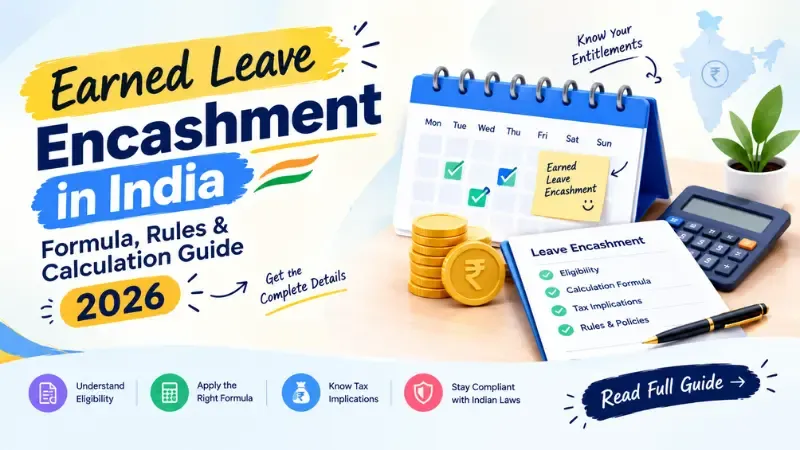
Earned Leave Encashment in India — Formula, Rules & Calculation Guide 2026
Earned leave encashment is a common source of payroll disputes when the formula is wrong — gross salary instead of Basic + DA, or a 26-day divisor instead of 30. This 2026 guide covers the exact formula, worked INR examples, state-wise carry-forward limits, the OSH Code 2020 update, and tax treatment under Section 10(10AA).
By Veenu Singh, Founder & CEO, TrackPM · Last updated: September 2026 · 9 min read
Earned leave encashment is the cash payment an employee receives for unused earned leave (EL) — either during active employment, at resignation, or at retirement. In India, it is a statutory entitlement under the applicable state Shops and Establishments Act or the Factories Act 1948 (now the Occupational Safety, Health and Working Conditions Code 2020), and a common source of payroll disputes when not calculated correctly.
This guide covers the exact formula, state-specific rules, the 2026 legal updates under the OSH Code, tax treatment under Section 10(10AA) of the Income Tax Act, and common mistakes Indian companies make when processing encashment.
The Earned Leave Encashment Formula in India
The standard formula used across Indian payroll systems and accepted by income tax authorities is:
Leave Encashment = (Basic Salary + Dearness Allowance) ÷ 30 × Number of Unused Earned Leave Days
Three points about this formula that matter for accurate calculation:
- 1. Use Basic + DA only — not gross CTC. HRA, special allowance, bonuses, and other salary components are excluded from the encashment base. Using gross salary instead of Basic + DA inflates the payout and creates audit risk. This single error is responsible for a significant portion of leave encashment disputes in Indian companies.
- 2. Always divide by 30 — not 26. Some HR teams use 26 as the divisor (excluding Sundays). This inflates the per-day rate by approximately 15% and is inconsistent with the Income Tax Department's interpretation and standard payroll convention. Use 30 consistently across your organisation.
- 3. Only earned leave and privilege leave qualify. Casual leave, sick leave, maternity leave, paternity leave, and compensatory off are not encashable under Indian labour law. They lapse at year-end if unused. Only EL/PL accrued and carried forward can be converted to cash.
Worked Examples in INR
Example 1 — Resignation encashment
Priya works at an IT company in Bengaluru. She resigns after 3 years of service.- Monthly Basic Salary: ₹40,000
- Dearness Allowance: ₹0 (most IT companies do not pay DA)
- Unused Earned Leave balance: 22 days
Encashment = ₹40,000 ÷ 30 × 22 = ₹29,333
This amount is added to her Full and Final (FnF) settlement and is fully taxable as salary income in the year of receipt.
Example 2 — Retirement encashment with tax exemption
Rajesh retires from a private IT company in Mumbai after 28 years of service.- Monthly Basic Salary at retirement: ₹1,20,000
- Dearness Allowance: ₹0
- Unused Earned Leave balance: 38 days (capped at Maharashtra's 42-day carry-forward limit)
Encashment = ₹1,20,000 ÷ 30 × 38 = ₹1,52,000
Since Rajesh is retiring, the exemption under Section 10(10AA) applies. The exemption for non-government employees is the least of:
- Actual leave encashment received: ₹1,52,000
- Ten months' average basic salary: ₹12,00,000
- Maximum statutory limit: ₹25,00,000 (effective April 1, 2023)
- Cash equivalent of leave to the credit: ₹1,52,000
The exemption is ₹1,52,000 — the full amount is tax-free at retirement.
Example 3 — Multi-state company complication
Vikram works for an IT company with offices in Delhi (HQ) and Chennai (branch). He is based in Chennai.- Tamil Nadu Shops and Establishments Act does not permit carry-forward of earned leave.
- His company's HR policy allows 30 days carry-forward (based on Delhi rules).
- At resignation, Vikram's leave balance shows 28 days carry-forward.
The correct approach: The applicable state act for Vikram is Tamil Nadu, which does not permit carry-forward. His company's policy (based on Delhi rules) cannot override the state floor — but in this case, Tamil Nadu's floor is actually zero carry-forward, so any policy offering carry-forward is more generous than the statutory minimum. The company may choose to encash — but this is policy, not statutory obligation in Tamil Nadu. HR should document the policy basis clearly.
This is exactly the kind of complication that arises when Indian IT companies with multi-city teams manage leave in spreadsheets rather than a system with state-specific configuration.
State-Wise Earned Leave Carry-Forward Limits — 2026
Each state's Shops and Establishments Act sets its own cap on how many earned leave days can be carried forward. Anything above this cap must be encashed or will lapse, depending on the state rules.
| State | Annual EL Entitlement | Carry-Forward Cap | Encashment Trigger |
|---|---|---|---|
| Karnataka | 18 days/year | 45 days | Balance above 45 must be encashed |
| Maharashtra | 21 days/year | 42 days | Balance above 42 must be encashed |
| Delhi | 15 days/year | 45 days | Balance above 45 must be encashed |
| Tamil Nadu | 12 days/year | Does not permit carry-forward | Must encash annually or balance lapses |
| Telangana | 15 days/year | 30 days | Balance above 30 must be encashed |
| Andhra Pradesh | 15 days/year | 30 days | Balance above 30 must be encashed |
For IT companies operating across multiple Indian states — a Bengaluru development team, a Mumbai sales office, a Chennai service centre — the leave policy must meet the statutory floor of whichever state each employee works in. A single company-wide leave policy based on the most lenient state rules can create legal exposure in stricter states.
2026 Update — OSH Code Changes to Earned Leave
The four new Labour Codes came into full force on November 21, 2025. The Occupational Safety, Health and Working Conditions Code 2020 (OSH Code) made two significant changes that affect earned leave encashment for Indian IT companies in 2026:
- 1. Eligibility threshold reduced from 240 days to 180 days. Under the old Factories Act, workers needed to have worked 240 days in a year to be eligible for earned leave. The OSH Code reduces this threshold to 180 days, bringing more employees (including those who joined mid-year, or those with significant leave or sick periods) into eligibility.
- 2. Accrual rate standardised at 1 day per 20 days worked. The OSH Code confirms 1 day of earned leave for every 20 days worked — the same rate as the old Factories Act. For an employee who works all 240 working days in a year: 240 ÷ 20 = 12 days of earned leave per year from the OSH Code's framework. State Shops and Establishments Acts may provide higher entitlements — Karnataka's 18 days and Maharashtra's 21 days remain in force as they are higher than the Code's floor.
Important: The OSH Code's Central Rules were finalised on May 8, 2026. Several states are still notifying their own state rules under the Code. Check the latest state-specific notifications before finalising leave policy updates for 2026–27.
Tax Treatment of Leave Encashment in India
During active employment (mid-tenure encashment)
Fully taxable as salary income in the year of receipt. Added to gross salary and taxed at the applicable slab rate. No exemption applies during active service.At resignation or termination
Fully taxable as salary income. However, if the employee claims relief under Section 89 of the Income Tax Act (for arrear income), the tax burden can be spread and reduced.At retirement (superannuation)
Exempt under Section 10(10AA) up to the least of:- Actual leave encashment amount
- Ten months' average basic salary (based on last 10 months)
- Cash equivalent of leave standing to the employee's credit at retirement
- ₹25,00,000 (lifetime aggregate limit — effective April 1, 2023)
Government employees receive full exemption on retirement encashment with no monetary cap. The ₹25 lakh limit applies to private sector employees only.
At death in service
Encashment paid to legal heirs is fully tax-exempt, with no monetary limit.Common Mistakes Indian IT Companies Make with Leave Encashment
- Using gross salary instead of Basic + DA. This inflates the payout, creates precedent for future employees, and causes TDS calculation errors. Always confirm the encashment base with your payroll team before processing.
- Not tracking carry-forward caps by state. A company with employees in Karnataka (45-day cap) and Tamil Nadu (no carry-forward) cannot apply the same policy uniformly. Employees in Tamil Nadu who accumulate leave expecting future encashment may find the balance lapses — leading to disputes.
- Processing FnF settlement without a leave balance audit. The most common trigger for post-resignation legal notices from former employees is incorrect leave balance at separation. Run a leave balance audit before processing the FnF settlement — not after.
- Encashing casual leave or sick leave. CL and SL are not encashable under Indian labour law. If a company has been doing this informally ("we paid him out for unused sick leave as a goodwill gesture"), it creates legal precedent and payroll tax complications. Document any out-of-policy encashment separately from the statutory EL encashment.
- Missing the FnF timeline. Under the OSH Code, final settlement must be paid within two days of the date of discharge, dismissal, or resignation. For superannuation or death in service, the deadline is two months. Most Indian SMEs currently operate on 30–45 day settlement cycles — the OSH Code's two-day requirement is materially tighter and creates compliance risk for companies that process FnF slowly.
How TrackPM Handles Earned Leave Encashment
TrackPM's payroll and office management modules handle earned leave encashment automatically — no manual spreadsheet calculation required.
The system tracks each employee's EL balance in real time, applies carry-forward caps based on their work state (Karnataka, Maharashtra, Tamil Nadu, Telangana, and others), calculates the encashment amount using Basic + DA at the correct per-30-days rate, processes it as part of the monthly payroll or FnF settlement, applies TDS correctly based on whether the encashment is during active employment or at separation, and generates the payslip component with the correct tax treatment.
For Indian IT companies with teams across multiple cities, this state-specific leave tracking eliminates the manual reconciliation that currently causes most leave encashment disputes.
Frequently Asked Questions
What is the formula for earned leave encashment in India?
The standard formula is: Leave Encashment = (Basic Salary + Dearness Allowance) ÷ 30 × Number of Unused Earned Leave Days. Only Basic + DA is used as the salary base — HRA, special allowance, and bonuses are excluded. The divisor is 30 — not 26. Only earned leave (EL) or privilege leave (PL) qualifies for encashment. Casual leave, sick leave, and compensatory off are not encashable under Indian labour law.Is earned leave encashment taxable in India in 2026?
During active employment, leave encashment is fully taxable as salary income. At retirement, non-government employees are exempt under Section 10(10AA) up to ₹25,00,000 (lifetime aggregate, effective April 1, 2023) — subject to the least-of-four test. At resignation or termination, encashment is taxable, though Section 89 relief may reduce the effective tax. Government employees are fully exempt at retirement with no monetary cap.How many earned leave days can be carried forward in India?
It depends on the applicable state Shops and Establishments Act. Karnataka allows 45 days carry-forward, Maharashtra allows 42 days, Delhi allows 45 days, Telangana and Andhra Pradesh allow 30 days. Tamil Nadu does not permit carry-forward. Under the OSH Code 2020 (in force from November 21, 2025), the framework is 1 day EL per 20 days worked, with state-specific carry-forward caps remaining in effect where they provide a higher entitlement than the Code.Can casual leave be encashed in India?
No. Casual leave cannot be encashed under Indian labour law. CL is a use-it-or-lose-it leave type — it lapses at year-end if unused. Only earned leave (EL) and privilege leave (PL) can be encashed. Some employers informally pay out unused sick leave or casual leave as a goodwill gesture, but this is not legally required and creates tax and compliance complications when done without proper documentation.What happens to earned leave when an employee resigns from an Indian IT company?
At resignation, the unused earned leave balance is calculated and encashed as part of the Full and Final (FnF) settlement. The encashment is calculated at Basic + DA ÷ 30 × unused EL days, taxed as salary income, and paid within two days of the last working day under the OSH Code's FnF timeline requirement. The leave balance should be audited before the FnF is processed — any discrepancy in the balance at this stage is the most common source of post-resignation disputes.Conclusion
Earned leave encashment errors are rarely malicious — they're almost always a Basic-vs-gross mix-up, a 26-vs-30 divisor slip, or a state carry-forward cap nobody was tracking. Getting the formula, the state rules, and the FnF timeline right protects both the employee's payout and the company's audit trail. TrackPM brings payroll and leave management together on one platform built for Indian compliance.