

Compensatory Off (Comp Off) Rules in India — 2026 Complete HR Guide for IT Companies
Compensatory off is one of the most commonly mismanaged leave types in Indian IT companies — and a common source of FnF disputes. This 2026 guide covers the legal basis under the OSH Code, Factories Act and state S&E Acts, comp off calculation, validity periods, and how to build a compliant comp off policy.
By Veenu Singh, Founder & CEO, TrackPM · Last updated: September 2026 · 8 min read
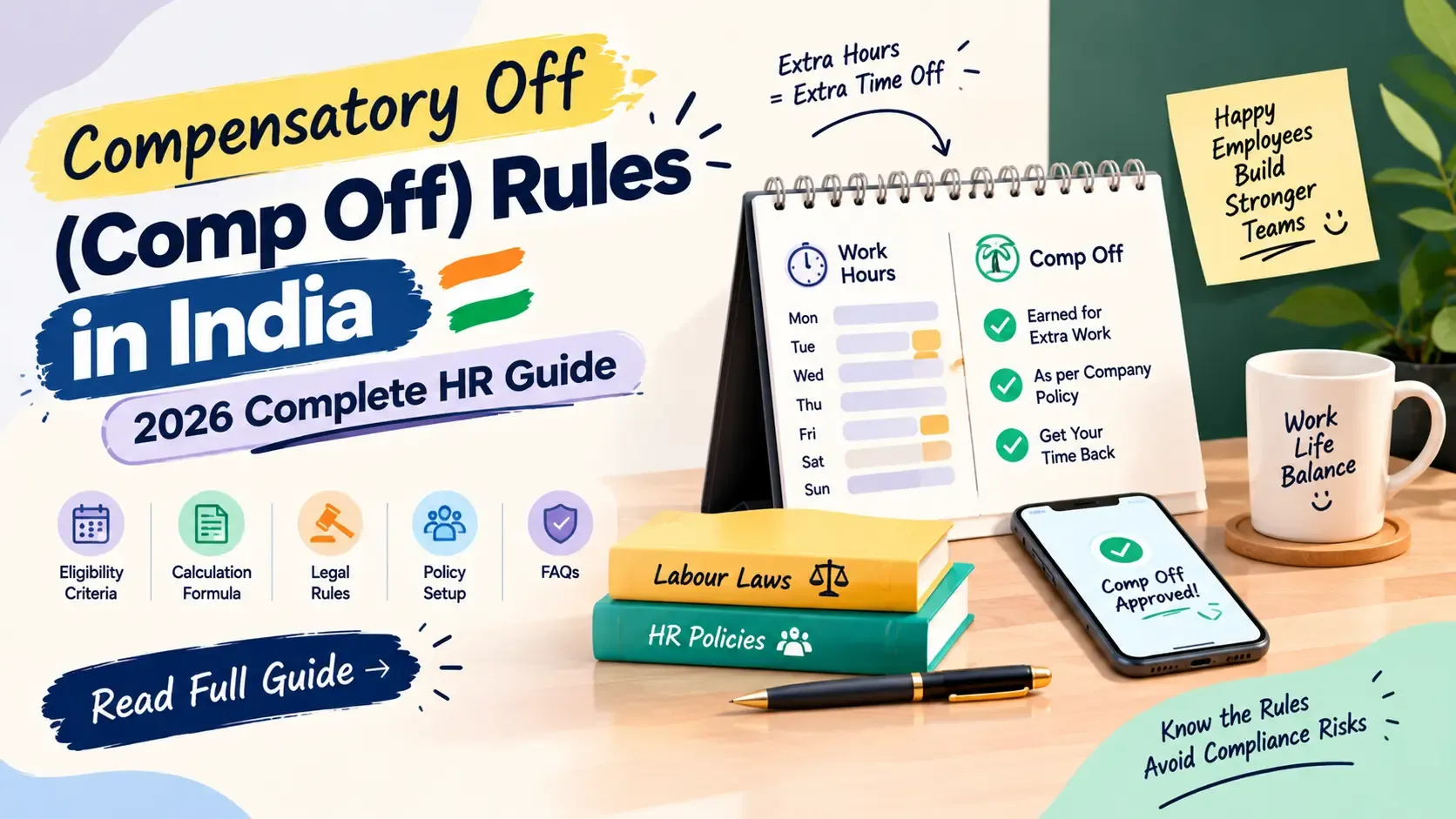
Compensatory off — commonly called comp off or C-off — is a paid leave day granted to an employee who works on a day they were entitled to rest: a weekly off (typically Sunday), a public holiday, or a company-declared holiday. Instead of paying overtime cash, the employer gives back an equivalent day of paid leave to be used within a defined window.
For Indian IT companies in 2026, comp off is one of the most commonly mismanaged leave types — and one of the most common sources of employee disputes, FnF settlement errors, and compliance gaps during labour audits.
This guide covers the legal basis, how comp off is calculated, validity periods, what happens when it lapses, and how to build a compliant comp off policy for an Indian IT startup or growing company.
The Legal Basis for Comp Off in India — 2026 Update
India does not have a single central law that exclusively defines comp off for all employees. The rules come from multiple overlapping laws depending on the type of establishment:
Factories Act 1948 — Section 52 and 53 (factory workers)
Section 52 of the Factories Act mandates that every adult worker must get one full weekly rest day. Section 53 states: if a worker is required to work on their weekly off, the employer must provide a compensatory holiday of equal days within the same month, or within the two months immediately following.For factory workers, this is a statutory right — not a policy choice. Failure to provide the compensatory holiday is a violation of the Factories Act.
State Shops and Establishments Acts (office and IT sector employees)
Indian IT companies operating as software or IT-enabled services establishments fall under their applicable state Shops and Establishments Act — not the Factories Act. Most state acts carry similar comp off provisions for office employees:- Karnataka S&E Act: Compensatory off must be granted within 3 days before or after the day worked on a holiday
- Maharashtra S&E Act: Substituted holiday must be granted within the same month or following month
- Tamil Nadu S&E Act: Compensatory rest day within the same week or following week
- Delhi S&E Act: Compensatory off within the week in which the extra work was done or the following week
OSH Code 2020 — Now in Force (November 2025)
The Occupational Safety, Health and Working Conditions Code 2020 consolidated 13 older labour laws including the Factories Act. The Code came into full force on November 21, 2025. Under the OSH Code:- Every worker is entitled to at least 1 full rest day per week (24 consecutive hours)
- If a worker works on their weekly off, the employer must provide a compensatory off within 3 days — either before or after the day worked
- If the employer fails to provide comp off within 3 days, the employee must be paid double wages for that day
- All comp off must be recorded in the attendance register — digital registers are explicitly permitted under the Code
This 3-day requirement is stricter than many state acts and many current company policies. Indian IT companies that currently operate on a "comp off within 30–60 days" policy should review compliance with the OSH Code's timeline.
How Comp Off Is Earned — Eligibility Rules
Not all weekend or late-evening work qualifies for comp off. The following conditions generally apply:
- 1. Pre-approval is mandatory. The extra work must be pre-approved by the employee's manager before it is performed. A developer who voluntarily works on Sunday without approval typically cannot retroactively claim comp off. The approval must be documented — an email, a system approval, or a manager's written confirmation.
- 2. The work must be on a designated rest day. Working late on a weekday (8 PM instead of 6 PM) does not typically qualify for comp off — it may qualify for overtime pay depending on hours worked. Comp off is specifically for working on: weekly offs (Sundays), national/state public holidays, and company-declared holidays.
- 3. Permanent or confirmed employees only (typically). Contract staff, freelancers, and probationary employees may or may not be eligible depending on the employment contract. Document eligibility clearly in your comp off policy.
- 4. Minimum hours worked threshold. Many companies set a minimum: working fewer than 4 hours on a holiday earns a half-day comp off; 4 or more hours earns a full day. Define this threshold in your policy and apply it consistently.
Comp Off Calculation — How Many Days Are Earned?
The standard earning ratio for comp off in Indian IT companies:
| Hours worked on holiday | Comp Off Earned |
|---|---|
| Less than 4 hours | 0.5 day (half day) |
| 4 hours or more | 1 full day |
| Full day (8+ hours) | 1 full day |
Some companies use a 1:1 ratio exclusively — any holiday work, regardless of duration, earns one full comp off day. This is simpler to administer and more generous than the tiered approach. Either is legally valid as long as it meets the statutory floor.
There is no legal requirement to grant more than 1 day comp off per day worked — even if the employee worked a 12-hour shift on a Sunday. The statutory obligation is to give back the rest day that was taken away. Cash overtime is a separate entitlement under the Code on Wages 2019 for hours worked beyond 48 per week.
Validity Period — When Comp Off Expires
Comp off is not like earned leave that accumulates indefinitely. It has an expiry date:
OSH Code timeline: Comp off must be given within 3 days of the day worked (before or after). This is the statutory minimum — it applies to the grant of the comp off, not the usage window.
Usage validity (company policy): Once granted, most Indian companies set a 30–90 day window for the employee to actually take the comp off as leave. The industry standard in 2026 for Indian IT companies is 60 days.
| Company | Standard validity period |
|---|---|
| Most Indian IT startups | 30–60 days |
| Mid-size IT companies | 60–90 days |
| Large IT/ITES companies | 90 days |
| Legal statutory floor | Within 3 days of work done (grant), then company policy applies for usage |
What happens when comp off expires unused? Under most company policies and state acts, comp off that is not availed within the validity period lapses — it is neither carried forward nor paid out. This is different from earned leave, which can be encashed. Comp off lapses because it is a rest obligation, not a financial entitlement. If employees consistently cannot use their comp off within the validity window, this is a workload management signal — not just an HR tracking problem.
Common Mistakes Indian IT Companies Make with Comp Off
- Tracking comp off in WhatsApp messages. "Take a day off next week" in a Slack DM or WhatsApp message is not a comp off record. When an employee raises a comp off dispute in an FnF settlement — and they regularly do — an informal message is not an audit-ready record. Use a leave management system where comp off is applied for, approved, tracked, and deducted from a balance.
- Not pre-approving the holiday work. Retroactive comp off claims — "I worked last Sunday, can I take Friday off?" — without any prior approval documentation create disputes because the manager may contest whether the work was actually done or needed. Require pre-approval via a formal system before work on a holiday begins.
- Applying the same comp off policy across all states. A company with developers in Karnataka and Tamil Nadu faces different state S&E Act timelines for granting compensatory off. A single blanket policy may inadvertently violate one state's requirement while complying with another's. Configure state-specific policies in your HR system.
- Forgetting comp off in FnF settlements. When an employee resigns, any pending unused comp off within its validity window should be settled — either by allowing the employee to avail it before their last working day, or by paying it out as per company policy. Comp off lapsing silently during notice periods is a common dispute trigger.
- Not complying with the OSH Code's 3-day grant timeline. Many Indian IT companies still operate on "we will give comp off whenever the employee applies for it." The OSH Code requires the comp off to be granted within 3 days — before or after the work day. If the company fails to do this, it legally owes double wages for that day. Document the grant date in your system, not just the availed date.
Building a Compliant Comp Off Policy for Your Indian IT Company
A good comp off policy for an Indian IT startup covers:
- 1. Eligibility: Who can earn comp off (permanent employees, confirmed after probation, full-time only).
- 2. Qualifying work: What work earns comp off (pre-approved work on weekly offs and public holidays only; not voluntary late stays on weekdays).
- 3. Approval process: How comp off work is approved (manager approval in writing before work is performed; system-based approval preferred).
- 4. Earning ratio: How many comp off hours are earned (half day for less than 4 hours, full day for 4 hours or more; or full day for any qualifying holiday work).
- 5. Grant timeline: When comp off is granted (within 3 days as per OSH Code; HR records the grant in the system on the next working day after the holiday work).
- 6. Usage validity: How long the employee has to use comp off (60 days from date of grant; unused comp off lapses after this window).
- 7. FnF treatment: What happens to unused comp off on resignation (company policy — either granted to be availed during notice period, or lapses, depending on balance and HR decision).
How TrackPM Manages Comp Off for Indian IT Teams
TrackPM's attendance and leave management module includes comp off as a dedicated leave type — separate from CL, EL, SL, and LOP.
When a team member works on a Sunday or public holiday: the manager approves the comp off in the system with the work date and hours logged. The system adds the comp off credit to the employee's balance with an automatic expiry date (configurable — 30, 60, or 90 days). When the employee applies to take the comp off, the system checks the balance, deducts on approval, and updates the team attendance calendar in real time. Expired unused comp offs are automatically removed from balances. At FnF, the system shows the exact comp off balance on the last working day.
For Indian IT companies with remote or hybrid teams across Bengaluru, Pune, Hyderabad, Delhi, and Mumbai — where tracking holiday work informally leads to month-end disputes — this system-based approach eliminates the WhatsApp-based comp off chaos.
Frequently Asked Questions
Is comp off mandatory for IT companies in India in 2026?
For factory workers, comp off is mandatory under Section 52–53 of the Factories Act and the OSH Code 2020. For IT and office sector employees, it is mandatory under most state Shops and Establishments Acts when an employee is required to work on a weekly off or public holiday. Under the OSH Code (in force November 2025), the comp off must be granted within 3 days of the work day, and failure to do so triggers a double-wage obligation. For Indian IT companies, comp off is effectively mandatory when employees work on designated holidays.How long is comp off valid in India?
The OSH Code requires comp off to be granted within 3 days of the holiday worked. After that, company policy governs how long the employee has to avail the comp off as leave. Industry standard for Indian IT companies in 2026 is 30–90 days, with 60 days being the most common. Comp off that is not availed within the validity window typically lapses — it is not encashable and not carried forward, unlike earned leave.Can comp off be encashed in India?
Generally, no. Comp off represents a rest obligation — the rest day taken away must be returned, not converted to cash. Unlike earned leave, comp off is not legally encashable under the Factories Act or most state Shops and Establishments Acts. Some companies choose to pay out unused comp off as a goodwill gesture during FnF settlements, but this is a company policy decision, not a statutory right. Document any such payment as a separate ex-gratia item in the FnF to avoid setting a precedent.What is the difference between comp off and overtime?
Comp off gives back time — one day worked on a holiday earns one day of paid leave. Overtime gives cash — hours worked beyond 48 per week (or 9 hours per day under many state acts) are paid at double the ordinary wage rate under the Code on Wages 2019. For salaried IT employees, most companies grant comp off rather than cash overtime. For hourly workers or those covered by the Factories Act, overtime cash payments are mandatory in addition to any comp off entitlement.How do I handle comp off when an employee resigns mid-month?
At the point of resignation, check the employee's pending comp off balance in the leave management system. Comp off earned but not yet availed has two options: allow the employee to avail it during their notice period (reduces attendance during notice, adjust accordingly), or follow company policy on FnF treatment. Do not automatically lapse pending comp off without reviewing it — it may create a dispute. Have a clear written policy and apply it consistently.Conclusion
Comp off disputes almost always trace back to the same two gaps — no pre-approval on record, and no system tracking the 3-day grant and 60-day usage clock the OSH Code and most state acts expect. Fixing both closes the gap in a single move. TrackPM's attendance and leave management module tracks comp off, CL, EL, and SL together, so Indian IT teams stop reconstructing holiday-work records from WhatsApp threads at FnF time.