


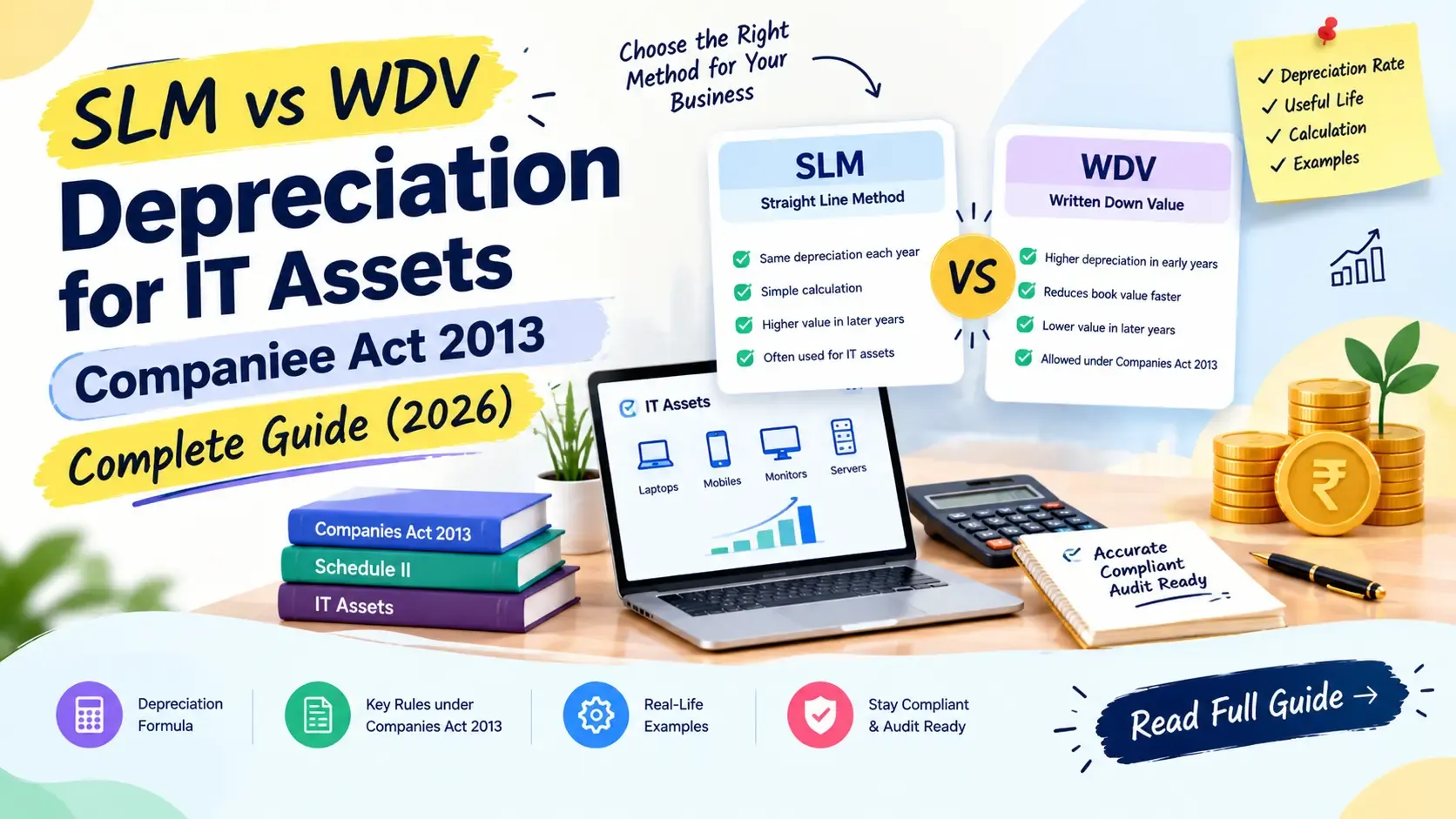
SLM vs WDV Depreciation for IT Assets — Companies Act 2013 Complete Guide (2026)
Depreciation is the systematic reduction in the value of a fixed asset over its useful life. This 2026 guide covers the exact Schedule II useful life for IT assets, the SLM and WDV formulas, Income Tax Act rates, worked INR examples for computers and servers, and how TrackPM automates the calculation.
By Veenu Singh, Founder & CEO, TrackPM · Last updated: September 2026 · 8 min read
Depreciation is the systematic reduction in the value of a fixed asset over its useful life. For Indian IT companies, the most relevant assets to depreciate are computers, laptops, servers, networking equipment, printers, and software — all of which fall under the IT asset category in Schedule II of the Companies Act 2013.
Under Section 123 of the Companies Act 2013, every Indian company must charge depreciation on its fixed assets before declaring a dividend. The method and rate are governed by Schedule II of the Act, which prescribes the useful life of each asset class — not a fixed depreciation rate. You derive the rate from the useful life.
This guide covers the exact Schedule II useful life for IT assets, the SLM and WDV formulas, the Income Tax Act rates (which are different from Companies Act rates), worked INR examples for common IT company assets, and how TrackPM automates this calculation.
Companies Act 2013 vs Income Tax Act — Two Separate Depreciation Regimes
Before going into the methods, the most critical point Indian IT companies must understand: you maintain two separate depreciation schedules — one for your books of accounts (Companies Act), and one for your income tax return (Income Tax Act). Using Companies Act rates in your tax return is incorrect and will be disallowed by the Income Tax Department.
| Parameter | Companies Act 2013 (Schedule II) | Income Tax Act 1961 (Appendix I) |
|---|---|---|
| Purpose | Financial statements, statutory audit | Income tax return, tax computation |
| Basis | Useful life prescribed in Schedule II | Fixed rates on WDV block of assets |
| Residual value | 5% of original cost | Zero (full cost depreciated) |
| Method allowed | SLM or WDV (company's choice) | WDV only (mandatory) |
| Rate for computers | Derived from 3-year useful life | 40% WDV on block of assets |
| Mid-year rule | Pro-rata from date of purchase | 50% rule — if used less than 180 days |
| Asset tracking | Per individual asset | Block of assets (all computers together) |
Maintain both schedules. The difference between them creates deferred tax, which is the most common source of timing differences in Indian IT company accounts under AS 22 / Ind AS 12.
Schedule II Useful Life for IT Assets — 2026
Schedule II of the Companies Act 2013 prescribes the following useful lives for IT-related asset categories:
| Asset Category | Schedule II Useful Life | SLM Rate | WDV Rate | Residual Value |
|---|---|---|---|---|
| Computers and data processing units | 3 years | 31.67% | 63.16% | 5% |
| Servers and networking equipment | 6 years | 15.83% | 25.89% | 5% |
| Printers, scanners, peripherals | 3 years | 31.67% | 63.16% | 5% |
| Office furniture and fixtures | 10 years | 9.50% | 18.10% | 5% |
| Motor vehicles | 8 years | 11.88% | 23.19% | 5% |
| Mobile phones and tablets | 3 years | 31.67% | 63.16% | 5% |
The 3-year useful life for computers is the most important number for Indian IT companies. Every laptop, desktop, and peripheral purchased must be depreciated over 3 years with a residual value of 5% of original cost — regardless of how long you actually intend to use the asset.
Companies may choose a different useful life if their technical assessment supports it — but this must be disclosed in the financial statements and justified. Most Indian IT companies use the Schedule II prescribed life without deviation.
The Two Methods — SLM vs WDV
Straight Line Method (SLM)
Under SLM, the same amount of depreciation is charged every year throughout the asset's useful life. The annual depreciation is:SLM Annual Depreciation = (Cost of Asset − Residual Value) ÷ Useful Life
Where:- Residual Value = 5% of Cost of Asset (standard under Schedule II)
- Useful Life = as prescribed in Schedule II (3 years for computers)
SLM results in equal depreciation expense every year. Profit and loss account shows a uniform charge. Asset book value declines in a straight line. Preferred by companies that want predictable, stable depreciation expenses.
Written Down Value Method (WDV)
Under WDV, a fixed percentage of the asset's reducing book value is charged as depreciation each year. The depreciation falls each year as the book value declines.WDV Annual Depreciation = WDV Rate × Book Value at Start of Year
The WDV rate under the Companies Act is mathematically derived so that the asset reaches exactly its 5% residual value at the end of its prescribed useful life. For a 3-year useful life asset with 5% residual value, the WDV rate is 63.16%.
WDV results in higher depreciation in the early years and lower depreciation in later years. It better reflects the economic reality of IT assets — a laptop loses most of its value in its first year, not uniformly over three years. Preferred by companies that want to reduce taxable profit in early years (though for the Companies Act, the choice between SLM and WDV does not affect your Income Tax liability — that uses the Income Tax Act's 40% rate regardless).
Worked Examples in INR
Example 1 — Laptop under SLM (Companies Act)
Asset: Dell laptop purchased for ₹85,000 on April 1, 2026Useful life: 3 years (Schedule II)
Residual value: 5% × ₹85,000 = ₹4,250
Depreciable amount: ₹85,000 − ₹4,250 = ₹80,750
Annual SLM depreciation: ₹80,750 ÷ 3 = ₹26,917 per year
| Year | Opening WDV | Depreciation | Closing WDV |
|---|---|---|---|
| FY 2026-27 | ₹85,000 | ₹26,917 | ₹58,083 |
| FY 2027-28 | ₹58,083 | ₹26,917 | ₹31,166 |
| FY 2028-29 | ₹31,166 | ₹26,916 | ₹4,250 (residual) |
Example 2 — Same Laptop under WDV (Companies Act)
WDV Rate for 3-year asset: 63.16%| Year | Opening WDV | Depreciation (63.16%) | Closing WDV |
|---|---|---|---|
| FY 2026-27 | ₹85,000 | ₹53,686 | ₹31,314 |
| FY 2027-28 | ₹31,314 | ₹19,782 | ₹11,532 |
| FY 2028-29 | ₹11,532 | ₹7,282 | ₹4,250 (residual) |
Key difference: Under WDV, ₹53,686 is expensed in Year 1. Under SLM, only ₹26,917 is expensed in Year 1. WDV shows lower profits in early years — relevant for companies managing reported profitability.
Example 3 — Server under WDV (Companies Act, 6-year useful life)
Asset: HPE ProLiant server purchased for ₹3,50,000Useful life: 6 years (Schedule II for servers)
WDV Rate: 25.89%
| Year | Opening WDV | Depreciation (25.89%) | Closing WDV |
|---|---|---|---|
| FY 2026-27 | ₹3,50,000 | ₹90,615 | ₹2,59,385 |
| FY 2027-28 | ₹2,59,385 | ₹67,155 | ₹1,92,230 |
| FY 2028-29 | ₹1,92,230 | ₹49,749 | ₹1,42,481 |
| FY 2029-30 | ₹1,42,481 | ₹36,888 | ₹1,05,593 |
| FY 2030-31 | ₹1,05,593 | ₹27,338 | ₹78,255 |
| FY 2031-32 | ₹78,255 | ₹20,255 | ₹58,000 ≈ residual |
Example 4 — Mid-year purchase (pro-rata calculation)
Asset: Laptop purchased on October 1, 2026 (halfway through FY 2026-27)Cost: ₹70,000 · SLM Annual Depreciation: ₹22,167
FY 2026-27 depreciation: ₹22,167 × (6/12) = ₹11,083 (6 months only)
Schedule II requires pro-rata depreciation from the date of purchase to the year end. This is one of the most common errors in manual asset registers — forgetting to pro-rate the first year.
Income Tax Act Depreciation — 40% WDV on Block of Assets
For your income tax return, depreciation on computers is calculated at 40% WDV under Appendix I of the Income Tax Rules 1962. This is a fixed rate applied to the block of assets — all computers are grouped together, not tracked individually.
Key differences from Companies Act:
- All computers (regardless of purchase date) are in one block — a new ₹85,000 laptop and an old ₹15,000 desktop add together as a ₹1,00,000 block
- Rate is 40% on the opening WDV of the block (adjusted for additions and disposals)
- If the asset is used for less than 180 days in the year of purchase, only 20% is allowed (half the normal rate)
- No residual value — the block continues at a very small number (never reaches zero due to WDV mathematics)
The deferred tax calculation:
Book depreciation (Companies Act) minus tax depreciation (Income Tax Act) creates a timing difference each year. When book depreciation is higher than tax depreciation, you record a deferred tax liability. When tax depreciation is higher, you record a deferred tax asset. This difference is reversed over the asset's life and must be disclosed under AS 22 / Ind AS 12.
Which Method Should Indian IT Companies Choose?
Choose SLM if:
- You want stable, predictable depreciation expense across years
- Your investors or lenders prefer consistent profitability in early years
- You manage many small-value assets where uniform tracking is simpler
- Your company is listed or preparing for listing — uniform expenses are easier to forecast
Choose WDV if:
- You want higher expenses in early years to reduce reported profit (valid commercial reason)
- You prefer a method that better reflects actual economic depreciation of IT assets (which do lose value rapidly in year 1)
- Your statutory auditor or CA recommends it for your specific industry
Important: Once you choose a method for a class of assets, you must apply it consistently for all assets in that class. You cannot use SLM for some laptops and WDV for others. The method must be disclosed in your financial statements.
How TrackPM Handles Depreciation for Indian IT Assets
TrackPM's asset management module calculates depreciation automatically for every asset in your register using either SLM or WDV method under Companies Act 2013 Schedule II.
For each asset you add: enter the purchase cost, purchase date, asset category, and depreciation method. TrackPM automatically applies the correct Schedule II useful life and residual value, pro-rates the first-year depreciation, and generates a year-by-year depreciation schedule. Finance teams can run the complete asset depreciation report for any financial year with one click — ready for statutory audit, board presentation, or investor due diligence.
For Indian IT startups managing 20–200 IT assets across multiple offices in cities like Bengaluru, Pune, Hyderabad, Delhi, and Mumbai, this replaces the error-prone Excel depreciation register that most finance teams currently maintain manually.
Frequently Asked Questions
What is the depreciation rate for computers under the Companies Act 2013?
Under Schedule II of the Companies Act 2013, computers and data processing units have a prescribed useful life of 3 years and a residual value of 5% of original cost. Using the SLM method, the effective annual rate is 31.67%. Using the WDV method, the rate is 63.16% per year on the reducing book value. These rates are not prescribed directly — they are derived mathematically from the 3-year useful life and 5% residual value.What is the depreciation rate for computers under the Income Tax Act?
Under Appendix I of the Income Tax Rules 1962, computers and computer software (including peripherals) are depreciated at 40% per year using the WDV method on the block of assets. This rate is fixed and applies to the total block (not individual assets). If the computer is used for less than 180 days in the year of purchase, only 20% is allowed in that year.Can a company use SLM for some IT assets and WDV for others?
No. Under the Companies Act 2013, the depreciation method must be applied consistently across each class of assets. If a company chooses WDV for computers, all computers must use WDV. The method can differ between classes — laptops on WDV and furniture on SLM is acceptable — but within a class, consistency is mandatory. The method used must be disclosed in the financial statements.What happens if an IT asset is sold before its useful life ends?
When an asset is sold, discarded, or written off before its useful life ends, the difference between the net book value (WDV at date of disposal) and the sale proceeds is either a profit on disposal (if sale proceeds exceed WDV) or a loss on disposal (if WDV exceeds sale proceeds). Both are recorded in the profit and loss account. For tax purposes, the sale proceeds are deducted from the block of assets, reducing the block's WDV for future depreciation.Does TrackPM support Indian depreciation calculation for IT assets?
Yes. TrackPM's asset management module supports both SLM and WDV depreciation methods under Schedule II of the Companies Act 2013. It calculates pro-rata depreciation for mid-year purchases, applies the correct useful life per asset category, maintains individual asset depreciation schedules, and generates audit-ready depreciation reports. It tracks assets across multiple locations and employee assignments — replacing the manual Excel asset register most Indian IT companies currently maintain.Conclusion
SLM vs WDV is not just an accounting formality — the method you choose, applied correctly under Schedule II, directly shapes your reported profitability, your deferred tax position, and how audit-ready your books are. Getting the useful life, residual value, and pro-rata calculation right for every laptop, server, and peripheral protects you at statutory audit and investor due diligence alike. TrackPM's asset management module automates this calculation so your finance team never has to rebuild a depreciation schedule in Excel again.