

How to Manage Leave and Attendance for Remote IT Teams in India (2026 Guide)
If you are managing a remote IT team in India, leave and attendance is no longer as simple as an office attendance register. Leave requests arrive on WhatsApp, get approved in a text reply, and somehow need to show up correctly in payroll — while employees across different states follow different holiday calendars and leave rules. This 2026 guide covers exactly how Indian IT companies of 5 to 150 people should track Casual, Earned, Sick, Maternity, and Comp Off leave, set up state-specific holiday calendars, and connect leave data directly to payroll so month-end never turns into a dispute.
If you are managing a remote IT team in India, you already know that leave and attendance management is not as simple as it used to be when everyone sat in the same office.
There is no attendance register. There is no way to see who is actually online. Leave requests arrive on WhatsApp, get approved in a text reply, and somehow need to show up correctly in payroll at the end of the month. Meanwhile, your developers in Bengaluru have different public holidays from your designers in Kolkata, and your HR lead in Noida is trying to track all of it on a spreadsheet that was last properly updated three months ago.
In 2026, over 30 percent of Indian companies operate with some form of distributed workforce — fully remote, hybrid, multi-city, or field-based. The challenge is no longer whether to support remote work. It is how to manage attendance and leave accurately when your team is spread across cities, time zones, and varying state-specific leave policies. This guide covers exactly how to do it — practically, for an Indian IT company of 5 to 150 people.
Why Leave Management Breaks Down for Remote IT Teams in India
The problems with manual leave management for remote teams are predictable, well-documented, and almost entirely avoidable.
- Leave requests disappear into chat history. When leave is applied via WhatsApp or email, it is approved informally. HR has no centralised record, the manager forgets to update the spreadsheet, and payroll has no idea whether a few days off were approved leave, loss of pay, or sick days. The most common source of payroll errors in organisations without integrated leave management is the manual transfer of leave data between systems.
- Different states have different leave rules — and most teams get this wrong. India's leave entitlements are governed by state-specific Shops and Establishments Acts, not a single central law. An IT company with employees in Karnataka, Maharashtra, Tamil Nadu, and Telangana must follow four different sets of rules for minimum Earned Leave entitlements, mandatory Casual Leave, and public holiday calendars. A single shared spreadsheet cannot handle this correctly — it handles it approximately, and approximate HR compliance creates real legal risk.
- Managers cannot see team availability when planning sprints. When leave data is scattered across chat apps and spreadsheets, sprint planning becomes guesswork. A developer assigned as sprint lead turns out to have approved Diwali leave that never made it into any planning tool, and the sprint falls behind.
- Loss of Pay calculations become disputes at month-end. Relying on manual spreadsheets in 2026 is a risk. In a remote-first world, approving leave via emails or paper forms is impossible to track accurately. When there is no system of record, month-end salary becomes a negotiation rather than a calculation, and HR has no audit trail to prove the policy was applied consistently.
The Leave Types Every Indian IT Company Must Track
Before you can manage leave for a remote team, you need to be clear on what you are managing. Indian IT companies must track these leave types at minimum:
- Casual Leave (CL) — Short-notice leave for personal reasons. Typically 6–12 days per year depending on the applicable state act. Usually non-encashable and non-carryforward.
- Earned Leave (EL) / Privilege Leave (PL) — Accrued over the year based on days worked. Typically 15–18 days per year. Encashable and carryforward rules vary by state.
- Sick Leave (SL) — For medical reasons. Typically 7–12 days per year. A medical certificate may be required after 2–3 consecutive days.
- Maternity Leave — 26 weeks for the first two deliveries under the Maternity Benefit (Amendment) Act 2017. Mandatory, fully paid.
- Paternity Leave — Not mandated by central law but increasingly offered as company policy. Many Indian IT companies offer 5–15 days.
- Compensatory Off (Comp Off) — For working on weekends or public holidays. Typically must be availed within 30–90 days.
- Loss of Pay (LOP) — When leave balance is exhausted. Deducted directly from salary. Calculation must be consistent and documented.
- Optional Holidays — In addition to mandatory state public holidays, many Indian IT companies offer 2–3 optional holidays per year from a declared list (Holi, Eid, regional festivals).
How Attendance Tracking Works for Remote IT Teams in 2026
Biometric machines only work for employees who are physically present. For remote and hybrid IT teams, you need cloud-based attendance solutions:
- Mobile app check-in — Employees mark attendance through a mobile app at the start and end of their workday, with optional GPS verification to confirm general location without surveillance-level tracking.
- Web browser check-in — For employees working from laptops, a browser-based attendance portal allows desktop clock-in and clock-out, recording start time, end time, and total hours automatically.
- Automatic time tracking integration — For IT companies that use time tracking software, attendance can be derived from active time tracked — when the employee is logging time on tasks, they are marked present automatically.
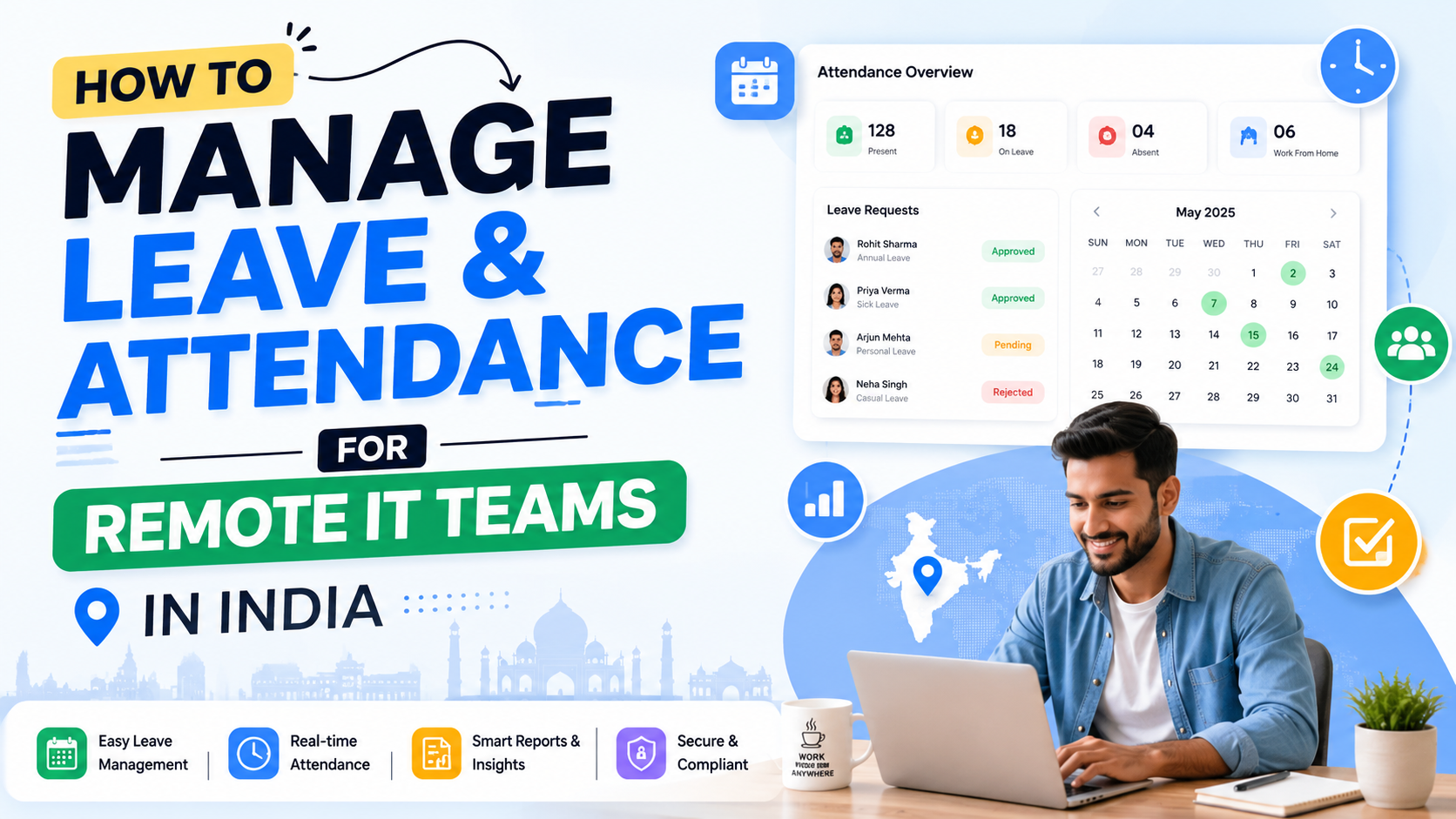
- Manager visibility dashboard — The entire team's real-time attendance status (present, absent, on leave, on comp off) is visible to the manager from a single dashboard, updated live throughout the day.
TrackPM's attendance and leave management software combines all of these — employees mark attendance through web or mobile, managers see real-time team availability, and all data flows automatically into payroll at month-end without any manual export or data re-entry.
5 Steps to Set Up Proper Leave Management for Your Remote IT Team
1. Define your leave policy in writing
Before any software can help you, you need documented leave policies. Write down: leave types offered, days per type per year, carryforward and encashment rules, approval workflow, and LOP calculation method. This document becomes the basis for your software configuration.2. Configure state-specific holiday calendars
If your team is spread across multiple Indian states, configure a separate holiday calendar for each state. National holidays are common; state-specific holidays differ. Multi-location and remote support is critical for companies with distributed teams across India.3. Give employees self-service access
Employees should be able to check their leave balance in real time, apply for leave directly through the system, see the status of pending requests, and view the team leave calendar before applying. When employees have visibility, approval conflicts reduce significantly.4. Integrate leave data with payroll
This is the step most Indian IT companies skip — and the source of most month-end payroll disputes. When leave data is connected to payroll directly, approved leave reduces the leave balance automatically, LOP days are calculated from actual attendance records, and salary computation reflects accurate payable days without any manual data transfer.5. Generate monthly leave and attendance reports
Run a monthly leave summary before payroll processing — not after. The report should show every employee's attendance days, approved leaves, leaves without pay, and remaining balance. Review it with HR before salary is calculated to catch discrepancies before they become disputes.Common Mistakes Indian IT Companies Make with Remote Leave Management
- Using WhatsApp for leave approval — There is no audit trail, no balance tracking, and no way to integrate with payroll. It works for 5 people. It fails for 15.
- Using a single national holiday calendar for a multi-state team — Employees in Bengaluru and Chennai have different public holidays. A single calendar gives wrong days to someone.
- Not tracking Comp Off — Remote IT teams frequently work on weekends for client deliverables. Without a Comp Off tracking system, these days are worked without compensation or proper leave credit.
- Approving leave verbally without recording it — When a manager approves a day off on a call and no one records it, payroll at month-end has no basis to not deduct that day as LOP.
- Forgetting to update leave balances when an employee resigns — Earned Leave encashment at the time of separation is a legal requirement under most state acts. Without accurate leave balance records, this becomes a dispute.
How TrackPM Solves Leave Management for Remote Indian IT Teams
TrackPM's office management software is built specifically for the Indian IT company context — remote teams, multiple cities, and the specific leave types and payroll compliance requirements that Indian companies deal with.
- Cloud-based attendance marking via web and mobile app — no biometric hardware required
- All Indian leave types pre-configured: CL, EL, SL, Maternity, Paternity, Comp Off, LOP
- State-specific holiday calendars for all major Indian states
- Leave approval workflow — employee applies, manager approves with one click, system updates automatically
- Real-time team leave calendar — see who is on leave before you plan sprints
- Direct payroll integration — leave data flows into salary calculation without manual transfer
- Monthly attendance and leave reports — generated automatically, available on demand
For a remote IT team of 10–100 people across Indian cities, TrackPM eliminates the spreadsheet chaos and the month-end payroll disputes that come from disconnected leave and attendance systems.
Frequently Asked Questions
What is the best leave management software for IT companies in India in 2026?
TrackPM is built specifically for Indian IT companies — it includes cloud-based attendance, all standard Indian leave types (CL, EL, SL, Maternity, LOP), state-specific holiday calendars, leave approval workflows, and direct payroll integration with PF, ESIC, and TDS compliance. It is affordable, quick to set up, and designed for teams of 5–150 people.Is it legal to require remote employees to mark digital attendance in India?
Yes. Digital attendance — through mobile apps, browser-based systems, or biometric tools — is legally valid in India and meets the record-keeping requirements under the Shops and Establishments Act applicable in each state. Digital attendance systems provide better compliance protection than paper registers for remote teams.How do I handle Casual Leave vs Earned Leave for remote IT employees?
Casual Leave is for short-notice, personal reasons — typically applied and approved the same day. Earned Leave is planned, accrued over the year, and usually requires advance notice of 3–7 days. In TrackPM, both types are tracked separately with their own balance, accrual rate, and carryforward rules, and the system enforces the correct policy automatically.How does leave management integrate with payroll for Indian IT companies?
In TrackPM, leave and payroll are directly connected. When an employee is marked absent without approved leave, the system automatically calculates Loss of Pay based on their per-day salary. When approved leave is used, the leave balance decreases. At month-end, payroll is calculated using the actual attendance record — no data needs to be manually transferred between systems.What happens to Earned Leave when an employee resigns from an Indian IT company?
Under most state Shops and Establishments Acts, unutilised Earned Leave must be encashed at the time of separation. The encashment value is typically calculated as (Unused EL days × Monthly basic salary) ÷ 26 working days. TrackPM's leave balance reports give you the exact unused EL balance per employee at any point, making separation settlements straightforward and audit-ready.Conclusion
Managing leave and attendance for a remote IT team in India does not have to mean chasing WhatsApp messages and reconciling spreadsheets every month-end. With documented policies, state-specific holiday calendars, employee self-service, and direct payroll integration, leave management becomes a system of record instead of a source of disputes. TrackPM brings all of this together in one platform built for Indian IT companies.